

Ukrainian Gender Narratives
The research focuses on gender narratives in contemporary Ukrainian society — the ways in which women and men explain gender differences, social roles, rights and responsibilities, assess changes in gender relations, and determine what they consider to be a fair gender order.
Drawing on qualitative interviews, the research team reconstructed ten gender narratives. Their manifestations in the public sphere were further examined through an analysis of six online discussions.
Full text of the research “UKRAINIAN GENDER NARRATIVES”
Download PDFKeywords: gender narratives, gender order, gender equality, femininity, masculinity, gender roles, gender stereotypes, normative expectations, freedom of choice, gender justice, Russia’s war against Ukraine, public online discussions.
RESEARCH TEAM


Writer and author of 11 books for children, teenagers, and adults. She is also a media analyst at the NGO CAT-UA and a researcher specializing in Russian propaganda and information warfare.

Doctor of Sciences in Social Communications, writer, and Head of the NGO CAT-UA, which has been providing communications analysis to Ukraine’s Defence Forces since the first day of Russia’s full-scale invasion. He is also an Associate Professor at the Educational and Scientific Institute of Journalism at Taras Shevchenko National University of Kyiv.
Project Lead
About the Research
Gender relations in Ukraine are shaped by societal changes, the development of gender equality policies, and Russia’s war against Ukraine. Expanding opportunities for women and men coexist with persistent traditional expectations surrounding motherhood, fatherhood, family provision, caregiving, and protection.
The war has brought renewed attention to issues of military duty, civic responsibility, reproductive choice, and the division of care work. At the same time, changes in the actual behaviour of women and men do not necessarily translate into corresponding shifts in societal perceptions of their roles.
The research examines the coexistence of traditional and emerging models of femininity and masculinity, the tensions between expanding opportunities and persistent normative expectations, and the impact of the war on the rethinking of gender relations.
Its findings aim to deepen understanding of contemporary gender-related tensions and inform the development of gender-sensitive policies and public communication strategies during the war and throughout post-war recovery.
TABLE OF CONTENTS
The research consists of three interrelated parts. The first examines the historical, social, and political factors that have shaped gender narratives in Ukraine. The second focuses on how women and men understand their own roles, rights, responsibilities, and societal changes. The third explores how these perceptions manifest in public online discussions.
1. Gender Narratives about Women and Men: Desk Research
In the first section, the authors analyse how perceptions of women’s and men’s roles in Ukraine have developed and evolved since the country gained independence to the present day.
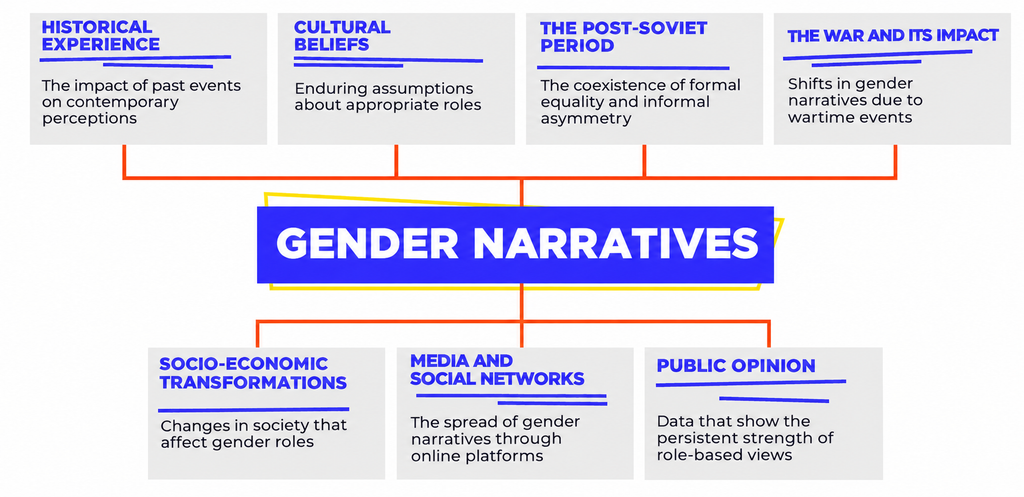
Drawing on sociological data, academic research, and analytical materials, this section examines the impact of societal transformations, public policy, European integration, and sociocultural expectations on gender relations.
Particular attention is paid to the period from 2022 to 2025 and the impact of the full-scale war on perceptions of motherhood, fatherhood, military duty, caregiving, and responsibility.
Main topics covered in this section:
- Gender narratives through the lens of sociological data.
- Gender narratives at the political level: from independence to the present day.
- Sociocultural expectations regarding the gender roles of women and men.
- Gender narratives in 2022–2025: war as a catalyst for redefining gender roles.
2. Narratives of Male and Female Identity: Qualitative Research
The second section is based on 51 in-depth interviews: 26 with women and 25 with men. The authors explore how people explain gender differences, assess changes in relations between women and men, identify sources of injustice, and envision a desirable future.
Drawing on the interviews, ten gender narratives were reconstructed — five female and five male narratives.
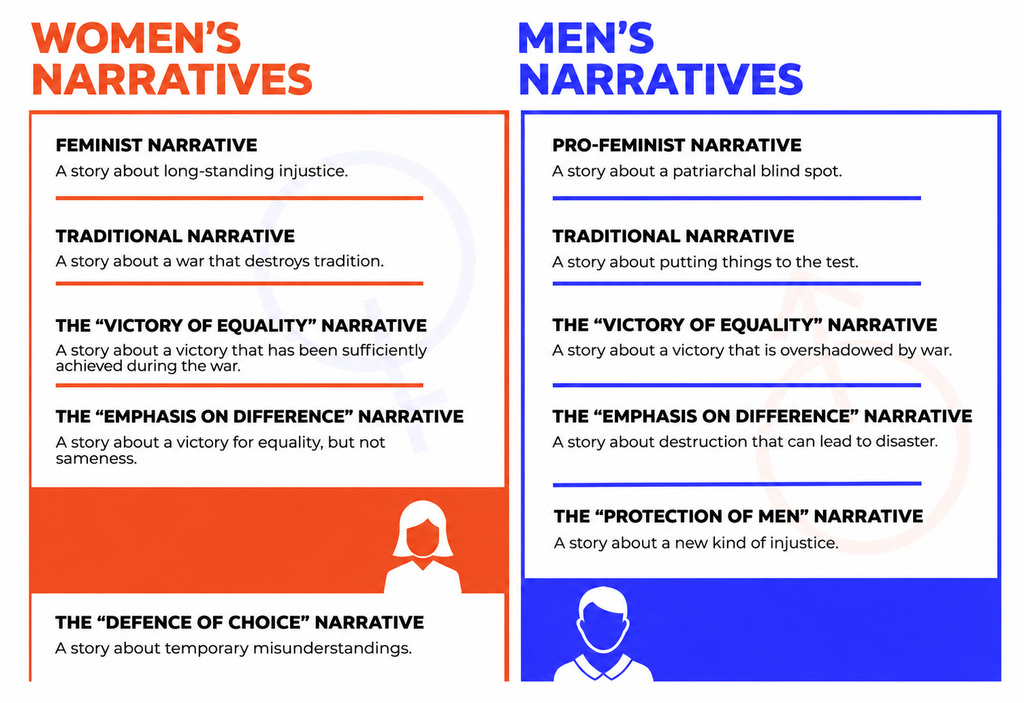
The analysis identified differences and commonalities in perceptions of gender roles, justice, personal choice, societal changes, and the future of relations between women and men.
3. Gender Narratives in Public Discussions: Quantitative Research
The third section examines how gender perceptions manifest in the public sphere and influence how people assess specific life choices and social situations.
The authors analysed 1,717 messages from six online discussions, selected on the basis of themes that emerged during the qualitative stage of the research.
Discussions analysed:
- The draft Civil Code, particularly the debate surrounding the possibility of marriage from the age of 14.
- Discussions on voluntary childlessness (being childfree) and reproductive expectations placed on women.
- The activities of the ‘Father Has the Right’ movement and conflicts surrounding parenthood, child custody, and the rights of women and men.
- Women’s military service.
- Ukrposhta’s controversial advertising campaign and the debate surrounding the sexualisation of girls and children.
- Singer MELOVIN’s engagement to a man and the debate surrounding LGBT visibility, traditional values, military uniforms, and the public visibility of same-sex relationships.
This stage of the research made it possible to examine how gender perceptions manifest in specific societal conflicts, what arguments participants use, and how their positions, normative expectations, and expressions of hate speech differ.
Conclusions and Recommendations
The final section synthesises the findings of all three stages and examines the contemporary gender order in Ukraine as undergoing a process of renegotiation.
Based on the findings, the authors propose ways to apply the research in public policy, education, civil society activities, and public communication.

The study was conducted by the civil society organization (CSO) Expert Resource Gender in Detail in partnership with the CSO CAT-UA, with financial support from the Askold and Dir Fund, administered by ISAR Ednannia, within the framework of the project “Strong Civil Society of Ukraine — a Driver of Reforms and Democracy”, funded by Norway and Sweden, and with additional support from the Ukrainian Women’s Fund.
The content of this publication is the sole responsibility of the CSO Expert Resource Gender in Detail and does not necessarily reflect the views of the governments of Norway or Sweden, ISAR Ednannia, or the Ukrainian Women’s Fund.



