


Read this text in Ukrainian as well.
Feminists of the world are the guardians of survivors of rape. We developed a profound theory to expose victim-blaming. We created sensitive language to provide care and support. We fight for justice and healing for those abused.
How did it happen that when the victim was not a person but a country, all these developments were forgotten?
Despite international law deeming Russia’s attack on Ukraine an unjustified act of aggression, the prevalence of victim-blaming narratives directed at Ukraine is nothing short of staggering.
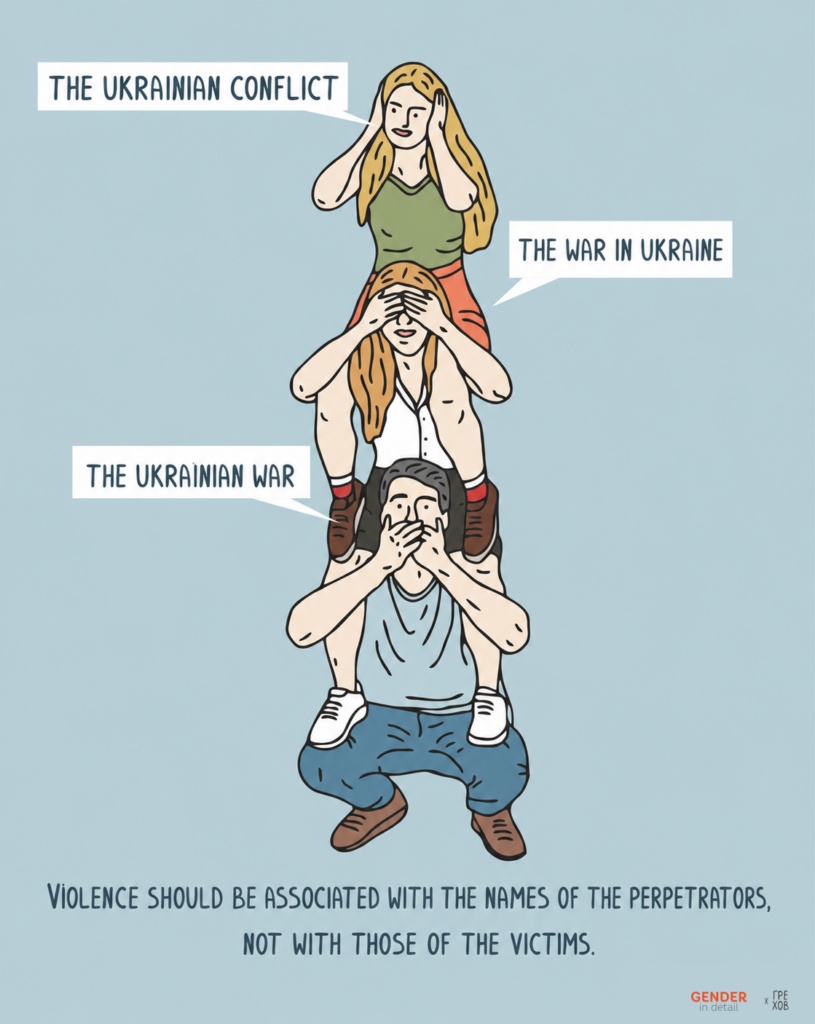
The nature of victim-blaming is always the same. It rests on three pillars.
The first: it is frightening to think that something similar could happen to you or your loved ones, so it feels safer to blame the victim for somehow behaving “incorrectly.” The unspoken promise is that if one behaves “properly,” everything will be fine.
The second: standing up for a victim requires effort — and courage — because it carries the risk of harm to oneself.
The third: a social structure — be it patriarchy, racism, or imperialism — that denies an oppressed group its rights, including the right to justice and the right to speak for itself.
What intrigues me most is that feminists in different countries have not noticed the obvious parallels between victim-blaming and the way people speak about Russia’s attack on Ukraine. These parallels are hard to miss, yet they remain largely unseen.
I want to make them clear.
The examples in this essay come from what my colleagues, friends, and I have personally heard from people in different countries — often from those with higher education, academic achievements, feminist beliefs, and best intentions.
It’s family business
The Russian war against Ukraine began in 2014 with the annexation of Crimea and parts of the Donetsk and Luhansk regions. Russia carefully concealed it, sending troops without identifying marks and later conducting so-called referendums in the occupied territories. The results of these referendums were not recognized internationally. Yet, the vast Russian propaganda machine worked to claim that there was a civil war in Ukraine. This explanation was very convenient — it allowed the international community to delay a response to violations of sovereign borders while continuing profitable trade with Russia.
It is as if you hear screams from a neighboring apartment at night and realize that a woman is being beaten and raped. But your neighbor is a respected, wealthy person, with whom it is just as risky to quarrel as it is profitable to have dealings.
So eventually, you and the other neighbors begin speculating about what really happened; perhaps she consents to, or even desires, the rough treatment.
Maria’s rape
We underestimate the scale and systemic nature of gender-based violence, in part because in our language it is seen as “belonging” to women. We read headlines that a woman was harassed, beaten, killed, raped, or that she spoke out and accused a man. Only after court verdicts do we see that someone like Harvey Weinstein was a serial rapist and abuser.
Violence should belong not to those against whom it is committed, but to those who commit it. It should be associated with the names of perpetrators, not victims.
Think of newspaper headlines: “The Ukrainian conflict,” “Ukrainian war,” “War in Ukraine.” Even “The Russian-Ukrainian war” is rare. And the correct term for this war — “Russia’s war against Ukraine” — is such a rare phrase that you are probably seeing it for the first time.
Do you know much about recent Russian wars?
They have been happening over the past 30 years, but you probably read about them under different names:
- 1990–1992 — War in Transnistria
- 1992–1993 — War in Abkhazia
- 1994–1996 — First Ichkeria War
- 1999–2009 — Second Ichkeria War
- 2008 — War in Georgia
- 2015–2024 — War in Syria
- 2014–present — War in Ukraine
We see the victim, but the perpetrator remains invisible.
All these wars share one thing that you would never guess from media headlines: they were all started and waged by Russia.
Perhaps, had global media in 2014 simply stated that Russia had begun yet another Russian war, the international community’s reaction would have been different, and Russia could have been stopped immediately.
She shouldn’t have provoked him
This is my favorite. It is typically employed by those who consider themselves terribly well-educated and intelligent. My Ukrainian feminist sisters and I have had to listen to a great deal of westplaining on geopolitics. That Ukraine wanted to join NATO too much, that it pursued European values and the path to EU membership too aggressively, that it didn’t cherish the Russian language and culture enough. And, in general, that it behaved with too much independence.
If Western feminists had to endure hearing from their colleagues, casually amidst the polite chatter of a scientific conference reception, that a victim was wearing a skirt that was too short, walking down the wrong street, or daring to refuse a suitor—they would surely have gone mad with rage and cancelled every single victim-blamer.
Ukrainians are forced to smile sweetly and search for arguments, even when all we want to do is scream. For were we to show righteous fury, we would simply be patted on the shoulder and declared emotional, traumatized victims from whom one cannot expect reason. Those we speak with would then go off to converse with other colleagues who keep a cool head and understand the full grandeur of the notion that Ukraine should not have provoked Russia’s war with a short skirt.
Perhaps you are now objecting that this is a manipulation, that NATO cannot be compared to a skirt. But if we agree that a woman has the right to do as she pleases, and that no one can violate her boundaries—then why, all of a sudden, does it become different when the subject is a country?
He has a right
Well, he is her husband, after all. She belongs to him. In many countries, marital rape is still not considered a crime. There is no need to explain to feminists that a man has no rights over a woman, no matter the nature of their relationship.
So why then did Ukraine suddenly begin to “belong” to Russia? Because it was occupied by it since the 17th century? Because of the Russian myths about three fraternal peoples that Putin so adores? No matter how hard Russia tries to impose the idea of a legitimate sphere of its interests, it does not exist until others accept it—until others concede that a man has the right of ownership over his spouse. I hope the world will consistently reject violence that masquerades as a right.
It’s a man’s business
Feminists around the world oppose the abduction of women and so-called honor killings, and it would never occur to anyone to agree that a woman’s body is a battlefield between men.
I have never heard of “proxy-rape,” but I have heard many times about a “proxy-war”—how America is fighting Russia with Ukrainian hands, how the USA and Russia are fighting each other (in Ukraine, for some reason).
If one reads the articles and speeches of Putin himself, he directly states that the Ukrainian people do not exist, that this territory is Russian, and his goal is to seize it, to exterminate everyone who considers themselves Ukrainian. He wants to destroy their language, culture, and identity.
This is precisely what Russians are doing in the occupied territories—they have closed Ukrainian schools, burned Ukrainian books, and forbidden the Ukrainian language. They kill, rape and torture. A strange war with the USA, isn’t it?
But this is also how rape is used in war: to destroy a people on a biological level. Not merely to inflict pain and suffering, but to genetically alter the population.
And no matter how many “proxy” prefixes one attaches to a war or a rape, it is still a crime that must be stopped and punished according to international law.
Why didn’t she just spread her legs?
“Why don’t you just give them the land?”
“She just needed to put up with it.”
“We would have accepted the occupation and done nothing.”
“So she spread her legs once, so what. Nothing terrible happened.”
“You just need to give up the territory, and then he’ll calm down.”
“She needs to agree to sex, and then it won’t be rape.”
Half of these phrases are utterly unacceptable in a civilized society. Ukrainians hear the other half regularly.
Defence make it worse
You cannot win. Russia is simply too large. Therefore, you must surrender as quickly as possible. Do not escalate with defence.
This view is shared by certain feminists who are actively demanding that the provision of arms to Ukraine be ceased.
This thought pains me as a woman. Men are generally stronger than women. In a physical fight, it is very difficult for women to defend themselves. Should we all just spread our legs and relax?
We devised rights, laws, courts, and police so that the law of the strong would not dominate on the streets. We devised international law for the same purpose. So why are we not defending it together?
She is unworthy
“Ukrainians are Nazis, uncivilized, and corrupt.”
“She’s a drug addict, an alcoholic, and a slut.”
All of feminist theory tells us that none of this is a justification for violence.
We should discuss problems and shortcomings of each and every society. We do. None is perfect.
However, such a conversation should not be used—especially at the international level—to replace the discussion of the causes of violence, nor to justify it.
He is a victim too
Of course, we can discuss how rapists are also victims of toxic masculinity.
But do you so often suggest that rape survivors should pity their rapist as you suggest Ukrainians should sympathize with Russians?
Do you seat the victim and the rapist at the same table right in the middle of the assault, and look on with fond affection as they sit together so nicely?
Do you ask the victim to think about the rapist’s mother and how she will suffer while he is in prison?
In fact, victims are asked about this. They are asked to pity the young man, not to ruin his life. But this infuriates us feminists, doesn’t it?
Pushkin, not Putin
My heart breaks when I think of all the women abused by Trump, Weinstein, and other famous bastards. What did those women feel every time their smiling abuser gave an interview on camera, surrounded by respect, success, and opportunity?
The Ukrainian request to cancel Russian culture is met with little understanding. Few people know that this culture has been used for centuries as a smokescreen for Russian crimes. While Tolstoy and Dostoevsky were translated and published, the literature of all peoples enslaved by Russia was not. While these authors were creating the image of the mysterious Russian soul, those who could have told of the genocides of their peoples were forced to remain silent and sink into oblivion.
Therefore, when Kirill Serebrennikov staged Modest Mussorgsky’s “Boris Godunov” at the Dutch National Opera in 2025, it was not merely culture. It was a denial of the chance for all victims to tell their stories.
Choice matter
I finish this essay on the day that Trump is meeting with Putin in Alaska. They say he will be met with honors and that a red carpet will be rolled out for him. A horrific war criminal, a bloody dictator who has killed millions of Ukrainians and Russians, who is abducting Ukrainian children and bombing peaceful cities, will be smiling for the cameras.
I cannot help but think that Russia could have been stopped.
In 2008 at the NATO summit in Bucharest, Ukraine and Sakartvelo (Georgia) had hoped to receive an invitation to the Membership Action Plan. However, they were denied this invitation, as members of the Alliance feared that it might provoke Russia.
Less than four months later, in August 2008, Russia launched a full-scale military invasion of Georgia.
In 2014, when Russia seized Crimea, the sanctions were weak. The Nord Stream pipelines continued to function, giving Russia the opportunity to earn billions from gas sales to finance the future greater war against Ukraine.
Every attempt to appease Russia has only resulted in it seizing more and more.
But no one seemed to learn from the obvious facts. Since 2022, Ukraine has been begging for weapons in dribs and drabs. We were told that we wouldn’t be given tanks, planes, or long-range missiles. Although finally all types of armaments were provided, precious time was lost, and most importantly—people.
This delay did not stop Russia at all. What stopped Russia was the heroism of Ukrainian soldiers—soldiers who are not some specially-bred specimens from the planet Mars, but our husbands and wives, brothers and sisters, colleagues, teachers, musicians, lawyers, those who in peaceful times are our clients and to whom we provide services.
In the end, it turned out that Russia can be provoked by weapons no more than a rapist can be by appearance. On the contrary—only force can stop them both.
The force of arms, law, solidarity—and of words. Words that shape how we think and determine how we act.
What if the media for the last 30 years were naming wars Russian regardless of who they were attacking?
What if, instead of victim-blaming discussions about how Ukraine provoked Russia, the world only spoke of unlawful aggression and how to stop it?
What if, instead of fearing the aggressor, we sought to punish him and protect the weak, to set an example for all potential perpetrators that they will get what they deserve?
What if the victims had the trust and the opportunity to tell their stories?
I don’t know what kind of appeasement Trump prepared for Russia this time. I know that unpunished evil comes back. I know that solidarity and small steps can change the world.


