


Civic activist, researcher, writer, Psychology student at the Ukrainian Catholic University (UCU), and winner of the All-Ukrainian Psychology Olympiad organised by KSE University.
Have you ever wondered why you can spend what feels like half your life waiting in line for the women’s restroom 1 , while the line for the men’s restroom moves almost instantly? Why your new smartphone doesn’t fit comfortably in your hand 2 , or why you constantly feel like wrapping yourself in a blanket at the office 3 ? It’s neither a coincidence nor a sign that there’s something “wrong” with you. It’s the result of a world designed around the “default human” 4 , historically assumed to be male. Let’s explore how the gender data gap makes women’s everyday lives uncomfortable and, at times, dangerously unsafe.
For centuries, the male body, experience, and way of life have been treated as the gold standard. As early as the fourth century BCE, Aristotle described the female sex as a “deviation from the type” in his treatise Generation of Animals 5. This way of thinking, in which male experience is considered universal while female experience is treated as secondary, has survived for thousands of years. Today, it is embedded in scientific research, technical standards, architecture, and medical protocols.
The “average person” 6 , as understood by designers and developers, is a man approximately 175–180 cm tall and weighing around 75 kg. Within this system, the female body is not treated as a standard in its own right, but as a more complicated variation that is less convenient to measure.
Medicine: When Symptoms Become “Invisible”
For a long time, medicine was developed around the male body 7. Women were systematically excluded from clinical trials 8 , partly because hormonal cycles were considered an “obstacle” to obtaining clean data. Even at the preclinical stage, most experiments are still conducted on male animals 9. As a result, medicine learned to treat a supposedly universal “human” who was, in fact, male.
The cost of this bias is measured in human lives:
- The classic presentation of a heart attack 10 , familiar from films (chest pain radiating down the left arm), is typical of men. Women may experience different symptoms, including nausea, jaw or back pain, and overwhelming fatigue. As a result, women are less likely to receive an accurate diagnosis and more likely to be sent home with a diagnosis of a “panic attack”.
- The dismissal of women’s pain 11 : In medical practice, women’s pain is still frequently dismissed as “psychosomatic” 12. On average, women wait 16 minutes longer than men to receive pain medication in hospitals 13. . Endometriosis is a telling example 14. . The condition, which affects one in ten women, takes an average of 7–10 years to diagnose after symptoms first appear. Throughout this time, women are told to “just put up with it”.
- Even CPR training mannequins 15 : Most cardiopulmonary resuscitation (CPR) training mannequins have male anatomy. Consequently, bystanders are less likely to attempt CPR on women in real-life emergencies because they lack confidence and practical experience working with female anatomy in critical situations.
Safety and Technology: From Body Armour to Laboratory Pipettes
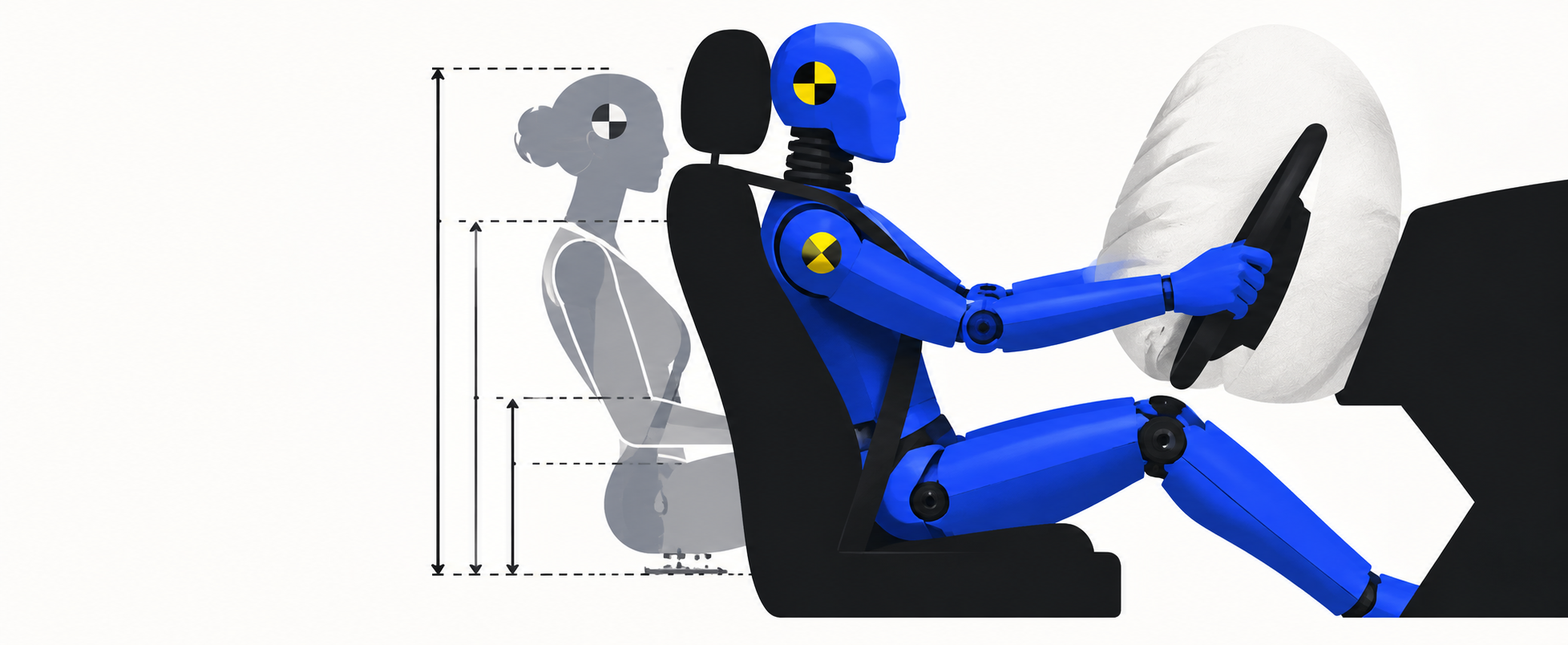
Safety systems have also been designed around the “average man”. For decades, car crash tests used only male crash-test dummies. Seatbelt tension and seat design were calculated using these models. Female anatomical characteristics, including differences in muscle mass distribution, shorter average height, and pelvic structure, were simply not incorporated into the models.
Women often have to sit closer to the steering wheel because of their shorter stature. However, airbags are designed to protect someone sitting farther away. A mechanism intended to save lives can therefore become an additional source of injury for women. As a result, women face a 73% higher risk of serious injury in a car crash 16. When researchers began testing “pregnant” crash-test dummies 17 , they discovered that standard safety systems could pose a deadly risk to the fetus.
Ukraine is experiencing a particularly acute dimension of this problem today. For years, women serving in the Armed Forces of Ukraine were forced to wear body armour and uniforms designed for men. Male sizing patterns do not account for breasts or differences in pelvic anatomy. This is not about appearance: an excessively long bulletproof vest makes running difficult, while an improperly fitted helmet restricts visibility. Fortunately, Ukraine is now actively introducing military uniforms designed for women 18. Yet the very fact that this happened only in the tenth year of the war demonstrates that the female body is still often treated as an “optional extra”.
The problem extends beyond warfare into everyday work and domestic life:
- Tools 19 : Drills, saws, and even laboratory pipettes require grip strength and hand spans that do not correspond to average female measurements. In scientific workplaces, women are more likely to experience hand injuries precisely because they work every day with tools that were not designed for them.
- Sports: Sports equipment is often marketed as “unisex” when it is simply a smaller version of a male design. However, differences in foot shape and wider pelvises affect movement biomechanics. Ignoring these differences contributes to ligament injuries 20 , which occur more frequently among female athletes.
Everyday Design: An Environment Where Discomfort Is the Norm
Women’s invisibility is most apparent in the hundreds of small design decisions we have come to accept as “natural”:
- Physical spaces 21 : The height of shelves, desks, kitchen countertops, and office chairs is based on a person approximately 175–180 cm tall. For women, this means constant compromise. In a standard office chair, our backs often cannot reach the backrest without our feet losing contact with the floor, contributing to chronic pain. Even the force required to open doors fitted with automatic closers 22 in public spaces is calculated around male strength.
- Smartphones 23 : Screen sizes continue to increase. This is convenient for people with larger hands, but often forces women to use both hands, contributing to strain in the hands and wrists.
- Office temperatures 24 : Temperature standards in office buildings were established in the 1960s based on the metabolism of a middle-aged man. Women’s metabolic rates are generally lower, which is why we are almost always cold in environments where our male colleagues feel comfortable.
- Urban planning 25 : Cities were long designed around a linear “home–work” commuting pattern. But women’s journeys, often shaped by caregiving responsibilities, tend to be more complex: daycare, supermarket, hospital, workplace. The lack of accessible ramps for strollers or well-lit public transport stops reflects the fact that planners simply did not consider women among the people who would use these spaces.
There is also an economic dimension to this problem. The so-called “pink tax” 26 refers to the higher prices charged for products marketed to women, from razors to clothing, compared with functionally identical products marketed to men. In other words, we pay more for products that are not even optimised for our needs. Just think of the tiny pockets in women’s jeans, which often cannot even fit a phone.
Conclusion: It’s Not About Ideology, but Quality
These examples are not necessarily the result of anyone’s malicious intentions. They are the outcome of a long history in which one half of humanity was treated as the standard, while the other remained invisible. And this affects not only women, but everyone who does not fit the parameters of an “average-sized cisgender man”, including non-binary people, people with disabilities, and older adults 27.
Researcher Caroline Criado Perez calls this the “gender data gap” 28. This is not merely a matter of abstract inequality. It is also a source of inefficiency. Systems built on incomplete information perform worse: they are more expensive to maintain, less safe, and require constant adjustments and fixes.
Recognising women’s experiences as part of the basic standard is neither a privilege nor an ideology. It is a step towards greater accuracy in science, safer roads, and more comfortable everyday lives. A world designed using complete data is a world where, at last, there is room for every one of us.
- Analytical article in The Guardian, “Gender-neutral bathrooms can save women from waiting forever in line” [↩]
- Scientific study by Leyk et al., “Hand grip forces of young men and women” [↩]
- Kingma, B., & van Marken Lichtenbelt, W. (2015). Energy consumption in buildings and female thermal demand. Nature Climate Change, 5, 1054–1056. [↩]
- The Guardian — “The deadly truth about a world built for men” [↩]
- Aristotle, Generation of Animals, Book IV, Part 3. [↩]
- Official scientific reference standard, “Reference Man”, International Commission on Radiological Protection (ICRP). [↩]
- Official historical timeline from the U.S. National Institutes of Health (NIH). [↩]
- The foundational publication Women and Health Research (National Academies Press), available through the NCBI Bookshelf [↩]
- Official NIH policy on “Sex as a Biological Variable” (SABV) [↩]
- Official guidance from the American Heart Association. [↩]
- Harvard Health article, “The dangerous dismissal of women’s pain” [↩]
- Study by Hoffmann and Tarzian, “The Girl Who Cried Pain: A Bias Against Women in the Treatment of Pain”, published in the Journal of Law, Medicine & Ethics. [↩]
- Study by Chen et al., “Gender Disparities in Pain Management”, published in Academic Emergency Medicine [↩]
- World Health Organization (WHO) fact sheet on endometriosis. [↩]
- Scientific publication in Circulation, a journal of the American Heart Association [↩]
- Press release from the University of Virginia (UVA) Center for Applied Biomechanics. [↩]
- Official Volvo Cars website [↩]
- Official announcement from the Ministry of Defence of Ukraine (December 2023). [↩]
- Lab Manager — “Pipette Ergonomics: Reducing Repetitive Strain Injury” [↩]
- Scientific review by Griffin, L. Y., et al., “The female ACL: Why is it more prone to injury?”, published in The American Journal of Sports Medicine. [↩]
- Failed Architecture — “Human, All Too Human: A Critique on the Modulor” [↩]
- ADA accessibility standards (Americans with Disabilities Act). [↩]
- Review of Caroline Criado Perez’s book in The Guardian. [↩]
- Boris Kingma and Wouter van Marken Lichtenbelt, “Energy consumption in buildings and female thermal demand”, published in Nature Climate Change (2015). [↩]
- OECD report, “Understanding Urban Travel Behaviour by Gender”. [↩]
- U.S. Government Accountability Office (GAO) report, “Gender-Related Price Differences for Goods and Services”. [↩]
- Inclusive Design Research Centre (OCAD University) [↩]
- Review of Caroline Criado Perez’s book in The Political Quarterly [↩]


