


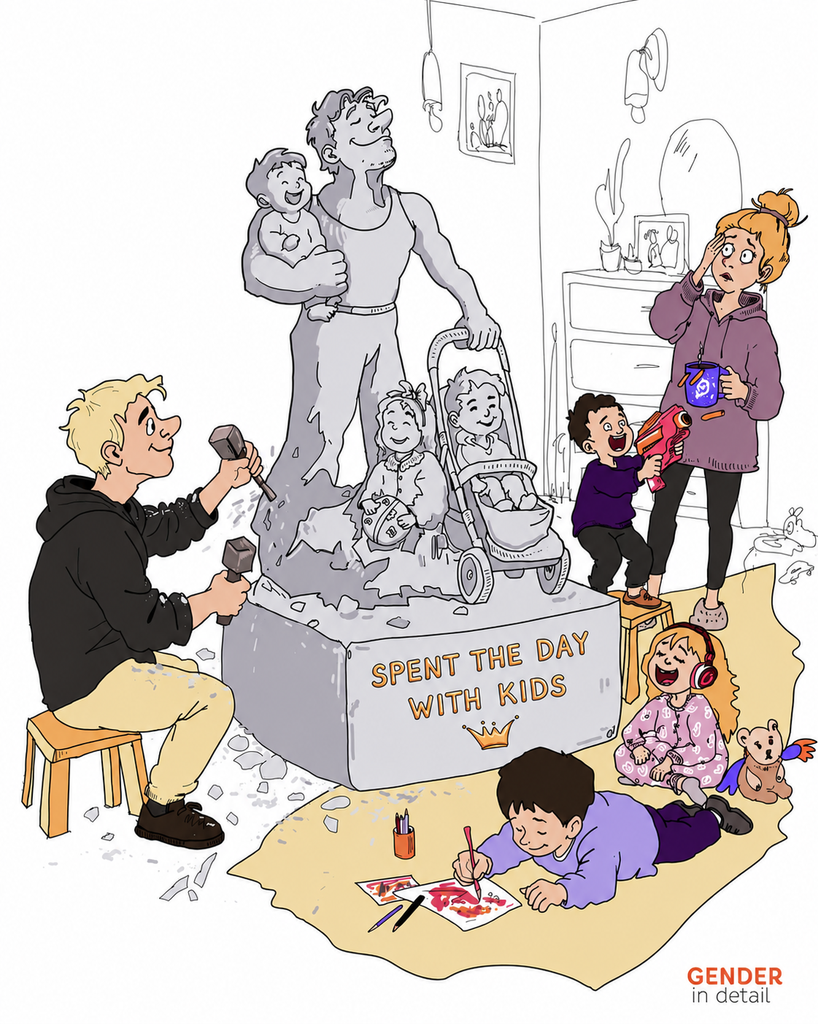
“Oh, even cats give birth. What’s the big deal?” — I heard this with my own ears, said about a woman’s role and work as a mother.
I also love the feminist joke that if men had periods, there would be monuments to them in the squares of every city.
Why did I think of this?
A recent survey by the Rating Group (2026) once again documented a paradox that has persisted for a long time.
Ukrainian society is very open to women as leaders and to their entering “male” spheres.
The statement “women are not ambitious enough for leadership positions” is rejected by an overwhelming majority — 81% of Ukrainians. This is even higher than the EU average, where 74% disagree with it, and significantly higher than in Poland (56%) and Hungary (61%).
At the same time, Ukrainian society remains very conservative when it comes to women’s roles in private life.
The statement “the most important role of a woman is to take care of her home and family” is supported by 66% of Ukrainians (the EU average is 42%, Slovakia — 75%, Bulgaria — 74%, Hungary — 71%). In other words, Ukraine follows the regional trend but is less conservative than its neighbours.
The view that “the most important role of a man is to earn money” is shared by 58% of Ukrainians, while 40% disagree. This puts Ukraine close to Romania (60%) and the Baltic states (55–60%), and noticeably above the EU average (42%).
For comparison, in Sweden only 14% of the population agree with the statement about women, and 10% with the one about men.
The same logic can be seen in how grant funding for gender equality is distributed. All kinds of leadership and mentoring programmes, programmes aimed at women’s economic empowerment and reskilling, initiatives to bring women into so-called male-dominated sectors, and microgrants are at the top of donor priorities.
It feels as though society is still waiting for “a woman to first become a man.” This is a quote from Nataliia Kobrynska, one of the first Ukrainian feminists, from a time when the word “human being” was not in common use and the word “man” was used instead, because in patriarchal society it was the man who served as the model and measure of humanity.
Kobrynska meant that a woman first had to become a human being: to gain rights, an education and a profession, and to have interests of her own, and only then become a wife and mother.
But we can see that even today, it is still women who are expected to measure up to men as the standard of humanity.
And so, as Ukrainian women become emancipated, they merely accumulate “shifts”: first their job, then the second shift (housework and caregiving), then the third (volunteering).
But is there no movement in the opposite direction? There is. There is just one catch.
When men enter typically female spheres, do you know what happens? They automatically gain a higher status there than the women who make up the majority in those fields.
The statistics are unforgiving. There are more women among school and hospital staff. But among the heads of these institutions, there are more men. And the higher the level of leadership, the more men there are.
From time to time, something associated with women becomes fashionable. Emotional intelligence or multitasking, for example. And as soon as it starts being monetised, coaches and experts immediately appear (men, of course).
The devaluation or underestimation of what has traditionally been considered “women’s work” does not disappear when men enter the field. Because they simply skim the cream off the top.
Still don’t believe me? Who are the best hairdressers (according to widespread stereotypes)? And the best chefs?
And while individual men build audiences for their courses on cooking, caregiving and emotional intelligence, women continue to do, on a massive scale and for free, the essential work without which we as humanity would not survive: washing, doing laundry, cleaning, cooking, feeding, teaching, and caring for children, sick people and older people.
Many invisible and unmonetised hours.
In terms of hours, things have become worse since the start of the full-scale invasion.
According to UN Women, women in Ukraine spent 56 hours per week caring for children in 2024, compared with 49 hours before the invasion (men spent 22 hours per week before the invasion). This is a direct consequence of the mass closure of childcare facilities, large-scale internal displacement, and the absence of men mobilised into the Armed Forces of Ukraine.
As a reminder, a standard working week is 40 hours.
At Gender in Detail, we work extensively on the issue of care work. I consider it one of the central issues for the feminist movement.
And it is not only about equalising the hours men and women spend on housework and care. Society’s perception of paid and unpaid work must also become more equal.
There is no more unfair stereotype than “he WORKS at his job, while she SITS at home with the children.”
We need to move away from defining the value of work by its monetary price.
And move towards understanding value as recognition of significance.
Then paid and unpaid care work will receive the attention and support they deserve.
Then we will be able to ensure generational replacement and overcome the demographic crisis.
Then we will become a fair and effective society.
No, those last three sentences were not written by AI. I really do think this. And I want to emphasise it.
Because is the work of a plumber at a water utility really more significant than the work of a preschool teacher?
Why, then, is it better paid from the outset?


