


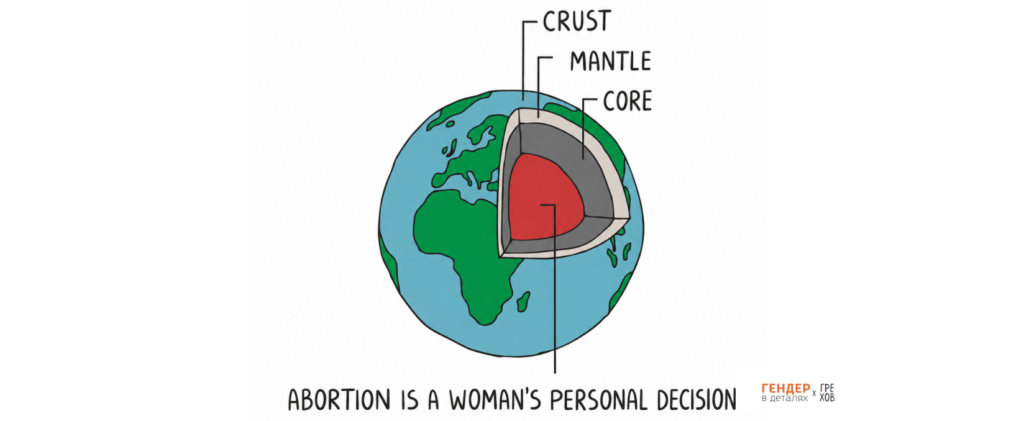
Every time I say that abortion is a fundamental right of women, a decision that belongs solely to a woman and is entirely personal, I receive comments such as “terminating a pregnancy should be a decision made by both partners” or “men should also have a say in whether a pregnancy is terminated or continued.”
Here is one recent example: “I wonder why you write in your post that contraception is the responsibility of both women and men (which I completely agree with), but when it comes to deciding whether to keep a child, it suddenly becomes ‘just a collection of cells’ and ‘men have absolutely no right to make decisions for women.’ Perhaps we should be fair and acknowledge that a man also has the right to decide the fate of his future child? It seems that you are not advocating fairness between men and women, but simply looking for any excuse to shit on men. That ‘mere collection of cells’ contains 50% of the man’s cells, and the woman willingly had sexual intercourse with him, resulting in the conception of a child.”
This position may seem logical, at least in situations where partners want to and are able to agree on what to do in the event of an unwanted pregnancy. However, it restricts a woman’s right to reproductive freedom when her wish to terminate or continue a pregnancy does not align with her partner’s wishes and puts her safety at risk.
Why is that? The risks associated with pregnancy are always greater for women than for men, because only a woman can become pregnant, and only she will risk her life, mental and physical health during pregnancy and childbirth, and go through postpartum recovery. Therefore, it is the woman who should make the final decision about what to do with her pregnancy. Likewise, a woman has the right to continue a pregnancy if she wishes, because it concerns her body and a fetus that will depend entirely on her body.
Below, I will respond to some common objections and questions I have received from people who hold the opposite view.
“But it’s their child together!”
At the stage when a woman can terminate a pregnancy, the fetus is not yet “their child together,” but an embryo that cannot exist independently of the mother’s body. The fetus also has no civil legal capacity. The Constitution of Ukraine states: “The right to life belongs to a human being from birth and is protected by the state.” In other words, life protected by law begins not at conception but at birth.
The language we use to describe pregnancy also matters. There is a difference between a fetus, an embryo and a child, and there are clearly defined stages of development before birth. “Language has become part of the struggle for abortion access… The words we choose can influence our attitudes towards abortion,” writes Laurie Ray, a nurse specialising in reproductive and sexual health, in a study for the reproductive health information platform Clue. The author points out that in the United States, where the struggle for women’s abortion rights continues, the respected newspaper The Guardian decided in 2019 to stop using the term “heartbeat bill” when referring to abortion restrictions in the US. Instead, editors and journalists were encouraged to use the term “six-week abortion ban,” as well as “anti-abortion” and “pro-choice” instead of “pro-life” and “pro-abortion,” respectively, for greater clarity and accuracy. This decision was intended to avoid inaccuracies and political manipulation in discussions of women’s reproductive rights.
To demonstrate the importance of language in the struggle for reproductive freedom, the author cited a 2015 Polish study by Małgorzata Mikołajczak, which examined how language used in abortion debates influences people’s attitudes towards the issue. The results showed that using the word “fetus” instead of “child” led to greater support for abortion rights.
“Then why do you say that both partners should take responsibility for contraception?”
Contraception is the responsibility of both partners because they share equal responsibility for it: both have the ability to take contraceptive measures. Although even here inequality persists. For example, oral contraceptives are still available only for women, not for men.
As explained by the educational podcast 11-a, the reasons for the absence of such medications lie in gender inequality, which slows down research into the development of contraceptive pills for men. Men’s complaints about the side effects of contraceptive medications are taken more seriously than women’s complaints, and men are often unwilling to take hormonal medications because of potential erectile problems.
Another widespread stereotype is that preventing pregnancy is a woman’s responsibility. Most of these prejudices indicate that we still live in a society that treats men’s reproductive health more seriously than women’s. However, prejudices also exist among women, some of whom say they would not be able to fully trust men to take contraceptives consistently.
“But surely they can reach an agreement!”
If people can reach an agreement, they can find the right solution together because their views align. But it often happens that one partner is determined to have a child while the other does not want one.
In such a situation, it is inhumane to force a woman to put her body through an enormous physical burden if she genuinely does not want to. Moreover, a woman risks becoming a victim of reproductive coercion. For example, she may decide to give birth because of emotional pressure from an abusive partner.
“Then why doesn’t a man have the right to refuse to pay child support?”
When a man avoids paying child support, he is evading his obligations towards a child who has legal capacity. When a woman terminates a pregnancy, she prevents the emergence of a person towards whom such obligations would exist.
As already mentioned, the fetus is a collection of cells and has no civil rights. Child support is a legal matter, while terminating a pregnancy is a matter of women’s health.
“Then how is this equality between women and men?”
Reproductive rights are not an area where decisions can be made symmetrically, because the reproductive functions of men and women are different. Moreover, there is no such thing as a 50/50 pregnancy that partners can share equally.
However, there is, for example, the possibility of providing psychological support to men whose partners have chosen to terminate a pregnancy.
Since September 2023, Finland has made it easier for women to access abortion procedures. At the same time, the government has been working to introduce psychological counselling for couples who have decided to have an abortion and for men whose partners have chosen to terminate a pregnancy.
We must remember that we still live in a society that perpetuates patriarchal stereotypes and seeks to control women’s bodies.
Discussions about a couple’s ability to reach an agreement are all well and good, but they must not become a means of manipulation used to create a “softer” and supposedly “fair” way of controlling women’s bodies.
Blurring the boundaries of women’s rights, including the right to reproductive freedom, is harmful. That is why it is essential for every woman to know that she has the final say in her reproductive decisions.


