

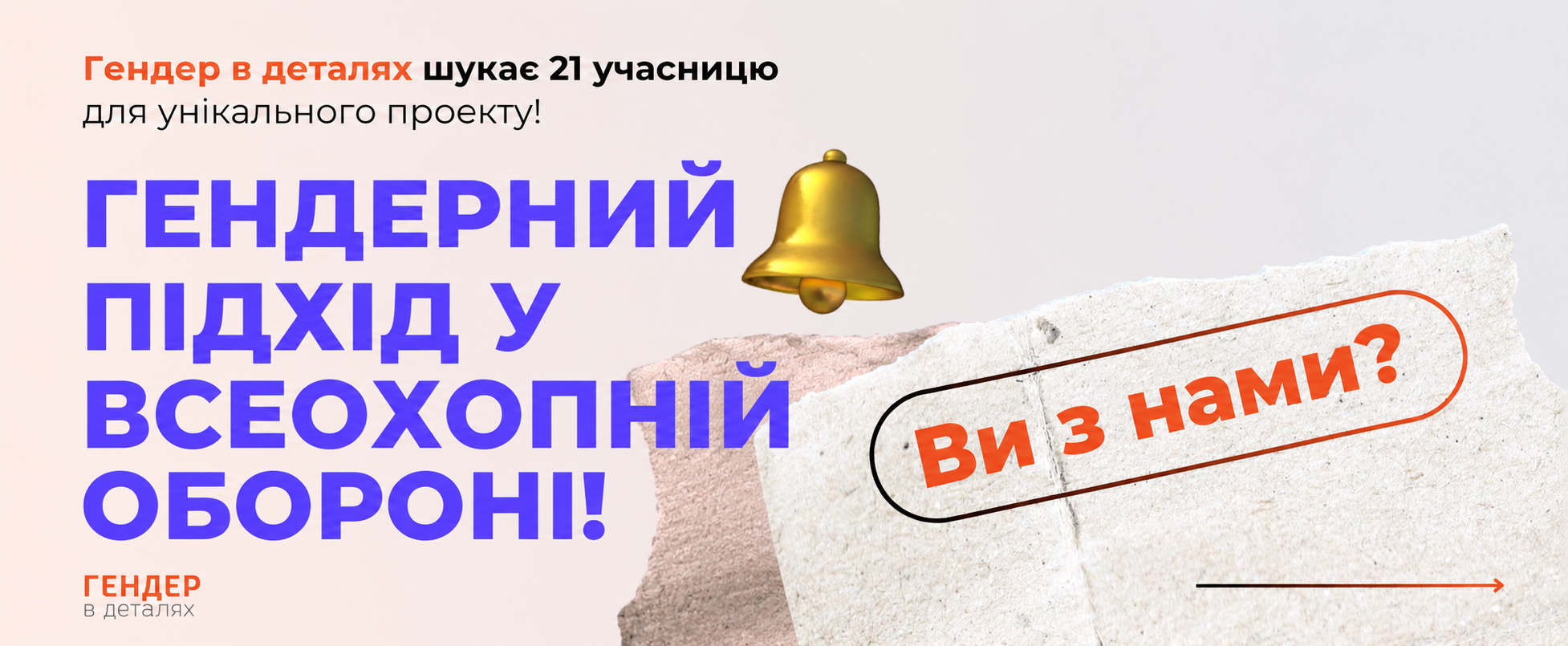
The expert resource “Gender in Detail” announces a call for participation in the research and training project “Gender Mainstreaming in the Context of Comprehensive Defence.”
Project rationale:
Ukraine’s victory in the war requires reforms in the defence sector and the search for innovative solutions in social policy that will ensure a resilient and comprehensive security strategy.
Gender Mainstreaming means taking into account the different needs, opportunities, and experiences of women and men in all areas of activity in order to ensure equal opportunities and unlock the potential of all citizens.
Comprehensive defence is a strategy that involves not only the army but the whole of society and its institutions in ensuring the country’s resilience to challenges and threats. A distinctive feature of comprehensive defence, following the Swedish model, is the inclusion in the doctrine of not only military but also other types of defence — economic, informational, cyber, psychological, and civil — aimed at supporting the functioning of the state even in crisis conditions.
Combining Gender Mainstreaming with comprehensive defence will increase defence effectiveness by ensuring the participation of all social groups, drawing on diverse experience, and increasing women’s contribution to strengthening the country’s security.
The project includes:
- studying best practices in Gender Mainstreaming and learning about the comprehensive defence system during a two-week offline training program in Sweden (11–23.05.2025);
- participants’ study of the Ukrainian context and development of proposals on gender-sensitive implementation of comprehensive defence in Ukraine (summer–autumn 2025);
- mentoring support from leading Ukrainian gender experts (summer–autumn 2025);
- writing analytical reports with practical recommendations (summer–autumn 2025);
- publication of analytical reports on the “Gender in Detail” website and their presentation to stakeholders (October 2025 – February 2026).
Participation in the project is free of charge for participants; costs are covered by the organizers. In addition, the program provides for a fee to participants of 58,000 UAH for writing analytical reports, provided all requirements are met, as well as the possibility of receiving additional grants to cover research expenses.
Project duration: 11 months (April 2025 – February 2026).
Number of participants: 21.
Participants will be organized into 7 research teams of 3 people each; each team will study its own research area to develop practical recommendations for necessary reforms. The result will be 7 analytical reports with recommendations, one from each team.
Areas of work:
- Changes in the economy, labor, and employment during the war. Strengthening economic resilience and sustainability of processes through Gender Mainstreaming.
- Care work in the context of defence. Paid care work: additional security burdens. Unpaid care work: increased burden, reduced infrastructure. Balancing market and state mechanisms to compensate for these problems.
- Women in the army. Barriers: gender-related, infrastructural, bureaucratic, symbolic. Women’s mobilization. Moving away from military standards (such as mandatory physical fitness testing, age restrictions for non-combat positions, or the requirement to hold officer rank rather than professional experience to fill positions) to enable more effective engagement of various social groups, including women, in the army.
- Women in civil defence and the security sector. Women’s involvement in mobile air defence groups and volunteer formations of territorial communities, the State Emergency Service (DSNS), the police, humanitarian demining, and the work of military-civil administrations. Experience, conditions, particularities, and problems. Care work and the balance between professional and family responsibilities among those employed in the security sector (DSNS, police, army).
- Local self-government and public administration. Expanding women’s participation in decision-making processes, particularly in responding to the challenges of war, and countering gender stereotypes. Proactively preventing restrictions on women’s political rights as a result of the war.
- Inclusive information policy. Countering gender-based disinformation. Supporting psychological resilience through effective communication, taking gender aspects into account in social campaigns, and creating resources to help cope with stress.
- The volunteer movement and civil society sector as an implementation of the comprehensive defence strategy. Recognition and support of women’s contribution to volunteer activity, ensuring gender balance in the management of civil society organizations, and increasing the visibility of women.
Requirements for participants:
We invite researchers and analysts of various profiles (sociology, legislative analysis, anthropology, political science, cultural studies, etc.) with confirmed experience in conducting research and writing analytical documents and practical recommendations (individually or as co-authors).
Mandatory requirements for candidates:
- experience conducting research and writing analytical documents and practical recommendations;
- gender sensitivity and a basic understanding of gender theory;
- working-level English;
- ability to work in a team;
- ability to participate in the full duration of the two-week offline training program in Sweden (11–23.05.2025) (all costs covered by the organizers);
- ability to write an analytical study on the chosen topic by October 2025 and to participate in meetings with stakeholders in the following months.
From candidates, we expect a CV, examples of your publications, a rationale for your desire to participate in the project, as well as your choice of preferred research area, your experience working in that specific area, and your thoughts on the particular topic you wish to work on.
Applications are accepted until February 23 via the application form. Selection decisions will be communicated no later than March 7.
The project is implemented by the expert resource “Gender in Detail” with financial support from the Swedish Institute, in partnership with the Swedish International Liberal Centre (SILC).


