


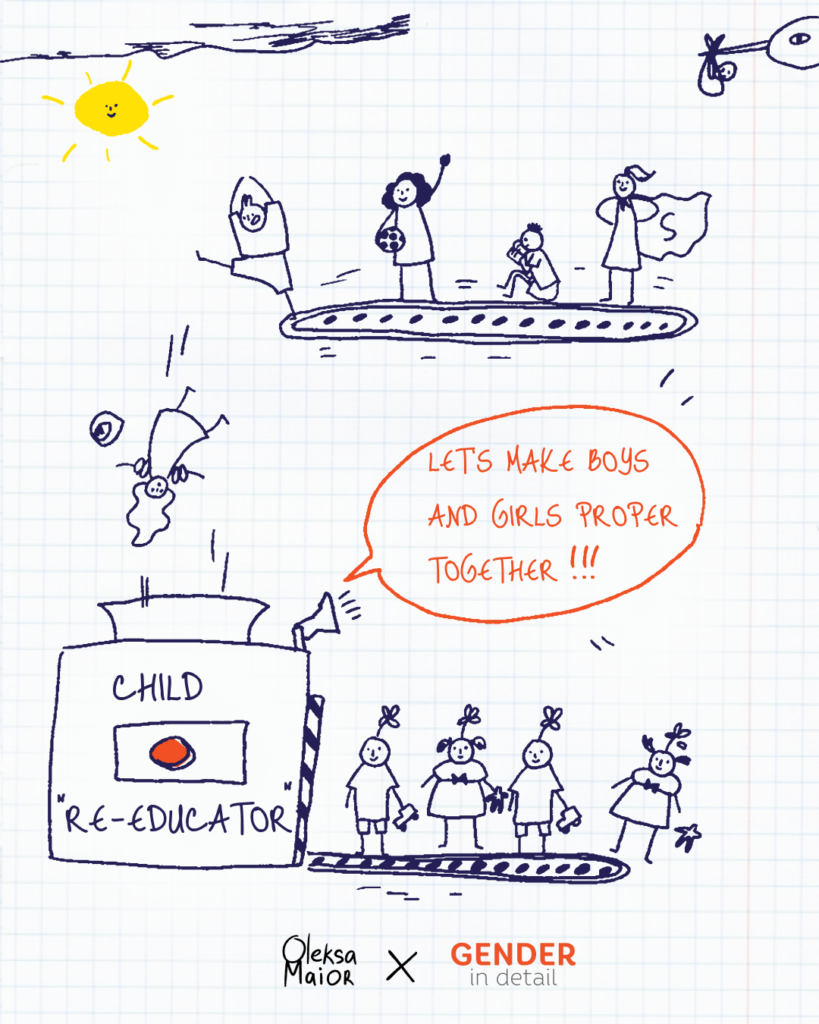
We want our children to grow up happy. The truth is, though, we have different ideas of what that happiness looks like.
But society’s image of a “properly behaved” child often comes with instructions as detailed as an appliance manual. A girl is expected to be polite, gentle, and willing to give way. A boy is expected to be strong, able to endure hardship, and ready to protect others. She should keep quiet; he should grit his teeth. And ideally, both should behave in a way that makes one thing clear to everyone around them: they’ve been raised well. They’re “easy” children.
This is how rigid expectations quietly creep into our conversations about happiness. And behind those expectations, we may stop seeing the child as an individual, with their own interests, wishes, and feelings.
A day in the life of a stereotype: how does it work in practice?
I remember a playground from my childhood. My friend fell, scraped his knee, and started crying. He was in pain. An adult automatically said, “You’re a man. Don’t cry!”
I got upset because someone had taken my favourite toy without asking. My grandmother said, “Why are you shouting? You’re a girl. Be gentler. You catch more flies with honey than with vinegar.”
In both cases, the child’s gender effectively becomes a form of censorship of their emotions. In the first, a child is taught to hide pain; in the second, disagreement and anger. Gradually, children learn which of their feelings adults are willing to accept and which are better kept hidden.
But why do children agree to “hide” who they are?
Children’s dependence on the adults closest to them is nothing new. These are the people who provide them with food, protection, and comfort. That is why their reactions carry particular weight.
From infancy, children notice our moods: when we hug them and when we turn away. If a boy is especially praised for swallowing his tears, while a girl is praised for quietly giving in, a child may internalise the message: “To be okay and to be loved, I have to hide my true feelings.”
Of course, it’s not just words that matter, but also the behaviour of the adults closest to them. Children notice who cooks dinner and who gets to relax afterwards. Who is reminded to help younger siblings. Who is taught to use tools. Whose tiredness is taken seriously and whose is treated as something ordinary.
Everyday remarks add fuel to the fire: “She’s going to make a great homemaker,” “He’s a real man,” “You’re so big already, and you’re still crying like a baby”…
Later, these rules may be reinforced in kindergarten and at school. A sensitive boy is called a “crybaby”, while an assertive girl is labelled “bossy” or told she’s “acting like a man”. To avoid ridicule and remain accepted by their peers, children may hide feelings and interests that don’t fit other people’s expectations.
Then there are the stories told through media and fairy tales. Think of classic animated films: Snow White or Cinderella, who cooks and cleans the house. Or the prince in Sleeping Beauty, who fights a dragon and rescues the heroine. These scenes reflect a familiar division of roles: she cares for others (or endures suffering, like Cinderella) and makes life comfortable, while he takes action without being allowed to show fear.
What’s more, the expectations we adults place on children often contradict one another. We may tell a boy, “Listen to your elders!” while simultaneously shaming him for asking for help instead of solving a problem himself “like a real man”.
We may encourage a girl to “Be a leader! Build a career!” while also expecting her to be patient, accommodating, and gentle. As the mother of a girl whom I call my warrior princess, I constantly encounter this contradiction. My daughter gets called a “tomboy”, “rude”, or “mannish”. These labels are used to make it clear that she doesn’t fit someone else’s idea of femininity.
If a child spends years growing up under pressure to conform, they may eventually find it difficult to distinguish between what they genuinely want and feel and what they have learned to allow themselves to want and feel according to someone else’s idea of a “real woman” or a “real man”.
And this brings us neatly to one of my favourite arguments:
“We didn’t have any of that growing up, and look at us — we turned out just fine.” A familiar argument in conversations about parenting.
But I’d like to suggest an experiment. Read the statements below and count how many times you answer “yes” if you’ve noticed these behaviours in yourself or people around you:
- Sometimes you find it difficult to explain what’s going on inside you. You might admit, “Everything annoys me,” but struggle to understand what’s actually behind that feeling.
- You take on more than you can handle but don’t dare ask for responsibilities to be shared.
- You feel guilty when you rest.
- You sometimes agree to physical touch or intimacy that you don’t actually want at that moment.
- You judge yourself mainly by how good you look, how well you care for others, how much you earn, or what you’ve achieved.
- You rarely ask for help, whether practical, medical, psychological, or simply advice from friends or loved ones.
- You often try to guess what other people expect of you.
- You feel ashamed to admit that you’re tired or struggling.
- You hesitate to try a new hobby, change careers, or leave a job that no longer brings you satisfaction.
- You feel ashamed of your body because it isn’t slim enough, muscular enough, “feminine” enough, or “masculine” enough.
- You keep problems in your relationship behind closed doors, even when you’re hurting or afraid.
- You often hear, “You’re the strong one,” or “You’re a man, you can handle it,” even though you haven’t felt strong or capable for a long time.
How many times did you answer “yes”?
Of course, these experiences may have causes other than gender expectations, but such expectations are often a significant contributing factor.
What can we do today?
Imagine a child loses a game and starts crying. We’re tired, we want to finish our tea, and the words are already on the tip of our tongue: “Why are you crying over something so silly?” To us, it really is a small thing. But we can hold back that remark and ask instead: “Are you upset?”, “How are you feeling?”, or “How can I help?”
We want our children to be able to stand up for themselves. But there’s a side effect: they start standing up for themselves with us, too. “I don’t want to.” “I don’t like that.” “Why did you decide for me?” And suddenly we’re tempted to end the argument with the ever-convincing “Because I said so!”
Listening to disagreement takes longer than demanding obedience. But sometimes there’s more behind it than simple stubbornness. Perhaps the child is afraid. Perhaps they haven’t understood something. Or perhaps we’ve genuinely overlooked something.
A child’s right to say no is also tested around relatives they don’t want to hug or kiss that day. We feel awkward, Grandma gets offended, and we’re tempted to quickly persuade the child to comply. But we can leave the choice up to the child by saying, “No hugs today. You can just say hello or wave instead.” Of course, it might feel uncomfortable in front of Grandma. But think how much this simple choice can mean for a child!
The same applies to praise. A girl figures out how to put together a complicated structure. A boy notices that his friend is sad and offers support. When we recognise resourcefulness, attentiveness, or kindness, we give children more room to grow. After all, they’re not just “pretty” or “strong”. They can also be inventive, capable, sensitive, empathetic, observant, curious, persistent, determined, caring, witty, and so much more.
These contradictions become especially visible in everyday family life. We may have recently explained to our daughter that she can choose any profession she wants when she grows up, only to automatically ask her, rather than anyone else, to clear the plates. Or we may allow a boy to cry but roll our eyes when his father admits he’s tired. Children notice both reactions.
Sooner or later, a child may point out the contradiction: “But you said we shouldn’t do that, and now you’re doing it yourself…” And we’ll be tempted to remind them who’s the adult in the house. Saying, “You’re right. I made a mistake,” isn’t always easy. But it shows children that adults, too, can reconsider their decisions and take responsibility for their actions.
If our goal is to raise a happy child rather than an easy one, every day will give us an opportunity to recognise that these two things are not the same.
The Academy of Care offers psychological support programmes for children under the age of 10 who are growing up during the war. We design these programmes with the needs of both girls and boys in mind, supporting every child’s right to their own feelings and interests. We invite parents who want to help strengthen their children’s psychological resilience to participate. https://www.academia-turboty-ngo.com/tut-i-zaraz/
Participation is free of charge. The event is supported by the German Government through GIZ.


