

Category: General

  • Harassment in Sports: How the Larry Nassar Case Triggered an Avalanche of Testimonies and Convictions

    Harassment in Sports: How the Larry Nassar Case Triggered an Avalanche of Testimonies and Convictions

    Atlanta 1996. I’d long wanted to rewatch those Olympic Games — my first viewing, when I was only three years old, had long faded from memory. Then, during the quarantine, the Olympic Channel decided to delight fans by uploading full recordings of the Games on YouTube, including gymnastics — which, in my personal universe of priorities, is a definite must watch. Not only because of our own Lilia Podkopayeva, but also because of the Magnificent Seven, as the U.S. women’s gymnastics team was famously called.

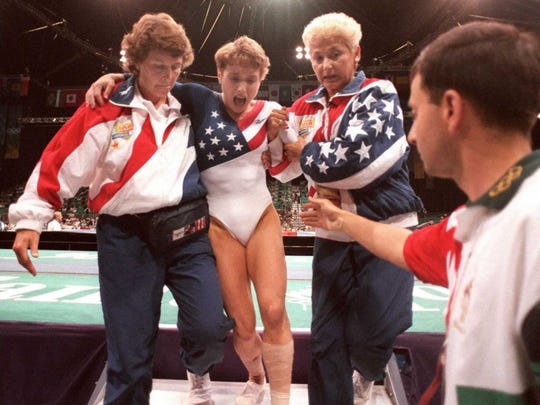
    Even knowing in advance who won the team final, I still got immense joy from those old broadcasts — until the very last vault. That was when I remembered what would happen next, and who would inevitably appear on screen. In a moment, Kerri Strug would injure her leg, and team doctor Larry Nassar would rush to her aid.
    The same doctor who would later be exposed as a pedophile, who had already been abusing gymnasts — even back then, in the 1990s.

    Trainer Martha Karoli (second from right) and doctor Larry Nassar help the injured Kerry off the platform.
    Trainer Martha Karoli (second from right) and doctor Larry Nassar help the injured Kerry off the platform.

    It was the first of four Olympic Games where Larry Nassar worked with the U.S. gymnastics team. His abuse went unpunished for two decades after Atlanta — and had already been happening for almost ten years before it.

    In 2017–2018, Nassar was convicted of possession of child pornography (60 years in prison) and of ten counts of sexual assault against minors — receiving 175 years for seven of them and an additional 40 to 125 years for the remaining three. The “ten” counts refer only to the official verdict. In reality, as of early 2020, Nassar had raped at least 517 girls and women over the span of three decades — those who found the courage to come forward.

    On June 24, Netflix released a documentary about this largest harassment case in sports history, titled “Athlete A.” The previous year, HBO had released another documentary on the topic — “At the Heart of Gold: Inside the USA Gymnastics Scandal.”

    The Nassar case was not the first, nor the only one — but it became a turning point. At the very least, public discussion and awareness of harassment in sports grew dramatically. Real systemic change will still take time, but the fact that the athletic community is now breaking the silence, acknowledging the problem, and ruthlessly (though not always consistently) removing abusers is already a major step forward.

    According to ChildHelp statistics,[1] 40–50% of athletes experience some form of abuse, and 2–8% face sexual abuse. Research by the Council of Europe within the Start to Talk initiative[2], aimed at protecting children from violence in sports, shows that one in five children experiences sexual harassment. Meanwhile, data from INSPQ[3] indicate that 98% of child harassment cases are committed by coaches, teachers, or instructors.

    Undoubtedly, the number one cause is the perpetrator. But why is sports such a fertile ground for their abuse?

    First of all, because the word “violence” is still often used almost interchangeably with the word “sport.” This is especially true in elite sports, where constant competition, pressure, and the chase for medals prevail. When athletes live under constant emotional and physical strain, they become accustomed to it and may no longer recognize it as harmful.
    Yelling, insults, and physical blows are still treated as “normal” — a supposed part of “discipline.” While the global sports world is trying to move away from such methods, they remain widespread across post-Soviet countries, where coaches who began their careers in the USSR — or those trained in that system — still dominate. Progressive voices advocating for change remain a small minority.

    Sexual abuse is often preceded by psychological and physical abuse. The perpetrators may not always be the same people, but a climate of anxiety, fear, and normalization of pain creates the perfect ground for adding yet another layer of harassment — another “sacrifice on the altar of sport” in the pursuit of Olympic glory.

    Another reason is isolation and lack of awareness.
    Athletes spend most of their time inside a closed “sports bubble” — surrounded by people who share the same routines, beliefs, and norms. This community develops its own version of “normal,” and unless someone steps outside that bubble and compares experiences, they may not even realize that what they consider ordinary others see as toxic.

    Children are the most vulnerable in this environment. Many simply don’t know what sexual abuse is because no one has ever explained it to them. From an early age, young athletes get used to the idea that their bodies don’t belong to them — everyone touches them, whether they want it or not: parents, relatives, coaches, doctors. Some of these touches can be painful or uncomfortable, making it difficult for a child to distinguish between what’s medically necessary and what’s inappropriate.
    Only now is society beginning to understand the importance of sexual education and respect for personal boundaries, especially when it comes to children.

    And one of the main reasons: respect — and fear — of authority.
    For many, going against a coach or a senior official is unthinkable. The old mentality of “the coach is the law” still dominates. Their authority is rarely questioned, and they are often supported by other influential colleagues.

    However, abusers are not always openly aggressive. A common manipulative tactic is “grooming” — masking abuse behind care and affection. Such individuals can appear kind, attentive, and charming: they flatter their athletes, bring treats forbidden by other coaches, joke with them, show interest in their lives, and win the trust of parents. This duality confuses children and teens, leading them to doubt their own perceptions: “Maybe they’re not that bad — maybe I misunderstood.”
    And for outsiders, it becomes even harder to believe that such a seemingly kind and friendly person could be capable of violence.

    All these factors appear again and again in almost every new case of harassment in sports.
    And revisiting these stories — starting with Larry Nassar — is necessary.
    Netflix, surely, won’t mind the reminder.

    Larry Nassar took root in sports medicine early in his career — in 1978. Over the years, he rose to become chief physician of the U.S. women’s gymnastics team, which he joined in 1986, and worked as an osteopathic doctor at Michigan State University (MSU) and other athletic clubs and schools. For 18 years (until 2014), he served as the national medical coordinator for USA Gymnastics (USAG) — the governing body for artistic, rhythmic, acrobatic, trampoline, and other gymnastics disciplines. In other words, Nassar had access to and influence over the entire medical system of American gymnastics.

    Most of his assaults took place either in his office or at his home, where he offered some athletes “private treatments.” During competitions — including the Olympic Games — he would invite gymnasts to his hotel room. After performing legitimate medical procedures, Nassar would proceed to what he called his “special treatment methods”: inserting his fingers into their vaginas and anuses, touching their breasts, masturbating in the corner or even in front of the athletes. He often managed to assault girls in the presence of their parents, positioning himself so they could not see exactly what parts of the body he was touching.

    Reports of Nassar’s abuse — both oral and written — had been sent to USAG leadership and individual clubs for decades, but action was only taken after 2015, when Sarah Jantzi, coach of gymnast Maggie Nichols, filed a formal complaint. Jantzi overheard her student discussing Nassar’s “treatments” with a friend and later discovered that the doctor had been sending Maggie inappropriate messages and compliments about her appearance.

    That report finally led to Nassar’s dismissal from USA Gymnastics. Michigan State University followed suit only in 2016, after the allegations gained national attention.

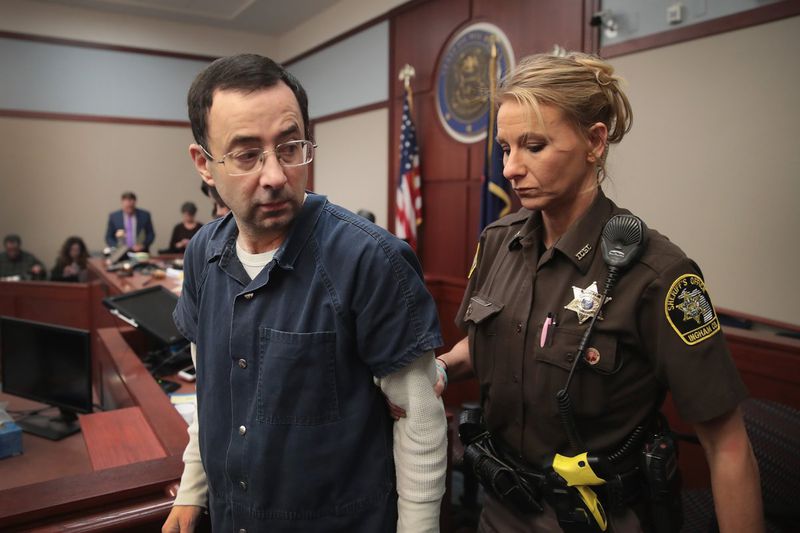
    Larry Nassar in court

    “1997, 1998, 1999, 2000, 2004, 2011, 2013, 2014, 2015, 2016 — these are the years when we spoke out about Larry Nassar’s abuse.”

    That’s how Olympic champion Aly Raisman began her speech when she and other survivors received the Arthur Ashe Courage Award at the ESPYs. Later it became known that reports had been filed even before 1997.

    “All those years, we were told: ‘You’re mistaken. You misunderstood. He’s a doctor. It’s normal. Don’t worry, everything’s under control…’ The greatest tragedy of this nightmare is that it could have been prevented. Predators thrive on silence… All we needed was one adult — just one decent adult — brave enough to stand between us and Larry Nassar,” Raisman said.

    The voice that was finally heard belonged to Rachael Denhollander — a lawyer and former gymnast who, in September 2016, told her story to The Indianapolis Star. Alongside her was the anonymous “Athlete A,” who later turned out to be Maggie Nichols. Their testimonies became the basis of the documentary “Athlete A.”

    Nassar began abusing Denhollander when she was 15. She had come to him for treatment of back pain.

    “Each time I lay on that table, trying to make sense of what was happening, I knew three things,” she said in court.
    “First, it was clear Larry did this regularly. Second, I was certain that some women and girls must have reported him to MSU or USAG officials. Third, I believed that if they knew what he was doing and hadn’t stopped him, then his treatment must have been legitimate. The problem had to be me, I thought. So I kept lying still. I didn’t know it then, but I was right about the first two.”

    In 2016, Denhollander not only spoke publicly but also filed a police report with extensive documentation: legal analyses of Michigan statutes, medical evidence of how pelvic floor therapy should actually be performed (a procedure Nassar used as cover), witness statements, expert lists, and personal journals describing her trauma — which Nassar himself read as part of the case file.

    “Did the leadership of USA Gymnastics and MSU expect this level of preparation from children before believing them?” the article asked rhetorically.

    Even this wasn’t enough for Michigan State University to take the accusations seriously — the institution initially sided with Nassar. One physician, Brooke Lemmen, testified in his defense, claiming there had been no penetration and suggesting the girl had “misinterpreted what happened,” saying:

    “When you’re 15, you think everything between your legs is your vagina.”

    Similar responses were given to other girls who tried to report the abuse.

    Three months after Denhollander’s story broke, Nassar was arrested. The FBI later found over 37,000 child pornography images and videos in his home — including footage of himself assaulting minors.

    Over the following year, more and more athletes came forward to share their traumatic experiences — and to expose the complicity of USA Gymnastics and MSU, which had ignored the abuse happening under their watch.

    Nassar wasn’t the only predator protected by USA Gymnastics. The organization had ignored complaints about William McCabe and over 50 other coaches. Some weren’t even banned — they continued working with children. McCabe was finally arrested in 2016, after a gymnast’s mother reported him directly to the FBI.

    Olympic champion McKayla Maroney revealed that USA Gymnastics paid her $1.25 million to keep silent about years of abuse by Nassar.

    “It started when I was 13 or 14,” Maroney wrote in her victim statement.
    “It seemed like whenever and wherever he had the chance, he ‘treated’ me — in London before we won Olympic gold, before I earned silver there. The worst night of my life was when I was 15. We were flying to Tokyo, and he gave me a sleeping pill for the flight. The next thing I remember, I woke up alone with him in his hotel room — and he was ‘treating’ me. I thought I was going to die that night…
    People need to understand that sexual violence doesn’t happen only in Hollywood or Congress — it happens everywhere. It seems that wherever there’s power, there’s potential for abuse. I dreamed of the Olympics, but what I had to endure to get there was unjustifiable and disgusting.”

    When court hearings began in January and February 2018, the number of survivors wishing to speak skyrocketed. Instead of the planned 88 statements, the court heard 204 testimonies over nine days — some in person, others in writing.

    Many said they found the courage to speak after watching the first brave women confront Nassar in court. One mother read a statement on behalf of her daughter, who had taken her own life after years of depression and trauma. Another father asked the judge for permission to have “five minutes alone in a locker room with this demon” before attempting to lunge at Nassar — stopped only by security.

    After one particularly emotional day, Nassar asked the court to stop hearing testimonies, claiming they were “too hard to listen to” and accusing the judge of turning the process into “a media circus.”
    Judge Rosemarie Aquilina denied his request.

    The last to speak was Rachael Denhollander, whose rhetorical question became symbolic of the entire trial:

    “How much is a little girl worth?”

    “When Larry was sexually aroused — when he found pleasure in our pain — his actions were evil and wrong,” she said.
    “I ask you to render a judgment that shows what happened to us matters. That we are worth everything — the fullest protection the law can give.”

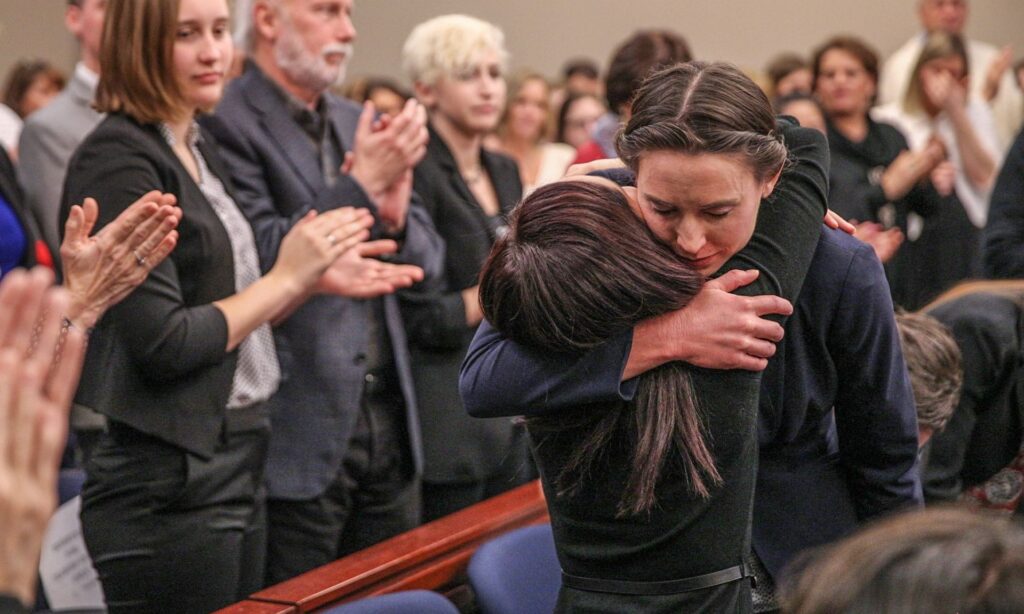
    Rachel Dengollander after her final court appearance

    The punishment of Larry Nassar himself did not mark the end of the case. Lawsuits flooded in against USA Gymnastics (USAG), the U.S. Olympic Committee (USOC), the Twistars Gymnastics Club, and Michigan State University (MSU). The entire leadership of USAG — including President Steve Penny — resigned (albeit reluctantly, under pressure from the USOC), as did MSU President Lou Anna Simon. Penny was later arrested on charges of evidence tampering, while Simon faced charges of providing false information to police.

    USAG also suspended John Geddert, head coach of the 2012 Olympic team and owner of Twistars — a close friend of Nassar, known for his aggressive and abusive training methods. One gymnast testified that Geddert once witnessed one of Nassar’s “treatments” but simply left the room after making a joke.

    In 2018, the Karolyi Ranch — the U.S. women’s gymnastics national training center founded by Béla and Márta Károlyi in 1981 — was shut down. It was there, many athletes later said, that the conditions most conducive to Nassar’s abuse were created. Parents were forbidden access, gymnasts lived under a climate of fear and bullying, trained through injuries, and developed eating disorders due to extreme dietary restrictions. Trust was nonexistent. Many survivors claimed that the Károlyis knew about Nassar’s actions, though the couple denied all allegations. Investigations into their role are still ongoing.

    The biggest systemic change came with the passage of the Protecting Young Victims from Sexual Abuse and Safe Sport Authorization Act of 2017. The law requires sports organizations to report all suspected abuse directly to law enforcement and led to the creation of the U.S. Center for SafeSport, an independent body tasked with investigating and preventing emotional, physical, and sexual abuse in American sports. The center also develops training programs and educational materials on athlete safety.

    However, the initiative quickly revealed serious underfunding issues. SafeSport receives an average of 230 new complaints per month, but lacks the staff and resources to handle them all. With a team of 40 employees — 24 dedicated to case management — the center was handling 1,200 active investigations as of early 2020. SafeSport’s first CEO, Shellie Pfohl, resigned in 2019, citing inadequate funding. Her successor, Ju’Riese Colón, continues the work.

    As of 2019, SafeSport’s annual budget was $11.3 million, twice what it started with, funded primarily by the USOC and national sports federations. This dependence has raised questions about its true independence, since SafeSport is tasked with investigating the very organizations that finance it. The only government funds it receives are small grants for educational initiatives.

    In its first three years, SafeSport sanctioned over 600 individuals accused of various forms of abuse. Yet these numbers don’t reflect the full picture — in several cases, courts overturned or reduced lifetime bans, including those against figure skating coach Richard Callaghan, taekwondo athletes Jean and Steven Lopez, and weightlifter Colin Burns.

    Meanwhile, investigations into the institutions that enabled Nassar have dragged on. In February 2020, the USOC and USAG offered $215 million in settlements to Nassar’s survivors in exchange for dropping lawsuits — a move that would effectively shield both organizations and individuals like Penny and the Károlyis from liability. Gymnasts including Simone Biles and Aly Raisman condemned the proposal as an attempt to bury accountability ahead of the Tokyo 2020 Olympics (later postponed due to the COVID-19 pandemic).

    A 2019 U.S. Senate report by Jerry Moran and Richard Blumenthal concluded that the FBI, USOC, USAG, and MSU had all the necessary evidence to stop Nassar at least a year before his arrest. The report also proposed new legislation to expand protections for athletes, empower Congress to dissolve the USOC and Paralympic Committee if necessary, and increase SafeSport funding to $20 million per year — a measure still under consideration.

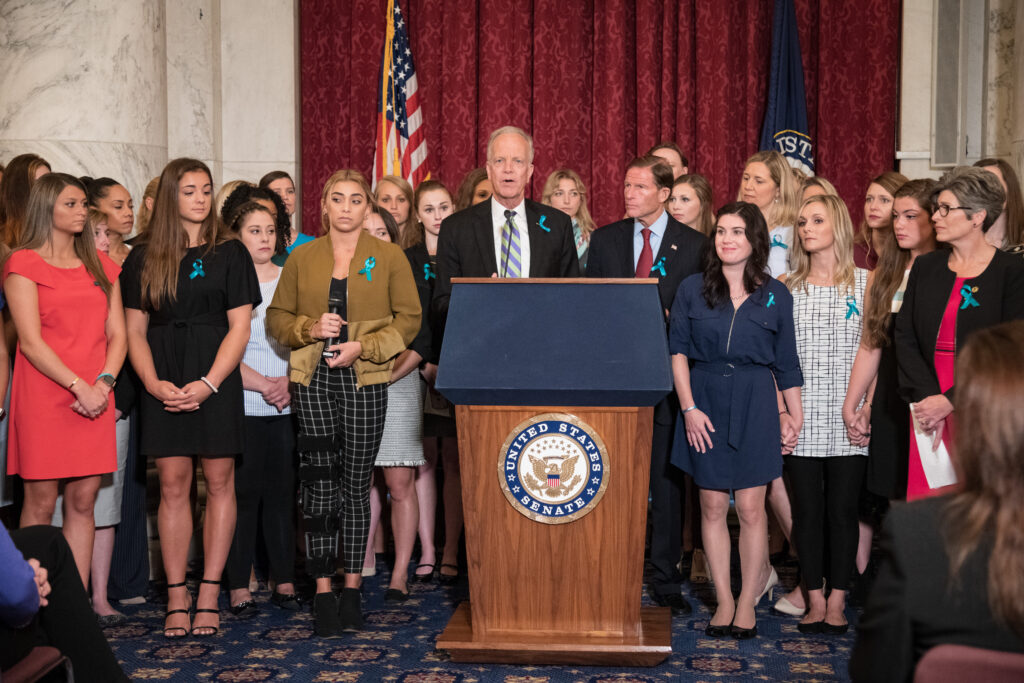
    Moran and Blumenthal with gymnasts at a press conference on athlete protection

    The campaign for its adoption is now being actively led by three-time Olympic swimming champion and human rights advocate Nancy Hogshead-Makar, who herself survived rape at the age of 19. Today, the former athlete heads the organization Champion Women, which advocates for safe sport, gender equality, and the elimination of discrimination against the LGBTQ+ community. Hogshead-Makar supported the creation of SafeSport and collaborates with Child USA, which fights against child abuse.

    In general, according to the SafeSport database, at the time of writing, 1,235 sports professionals had been temporarily or permanently suspended for various forms of abuse. The most bans are in gymnastics (227), swimming (186), and hockey (117). And if the imbalance in cases of violence committed by men surprises or unsettles you, note that in gymnastics, where there are the most cases, 219 of the suspended individuals are men and only 8 are women. This is partly because the vast majority of coaches and sports administrators are still men. According to the International Olympic Committee, at the 2016 Rio de Janeiro Olympics, 89% of accredited coaches were men.

    SafeSport’s rulings date back to the early 1980s and apply only to the United States. It is also important to note that professional sports leagues such as the NBA/WNBA and the NFL are not under the center’s jurisdiction.

    The example set by American gymnasts and the #MeToo movement, which peaked during the Nassar trial, inspired other athletes to speak out about the violence they had experienced.

    For Belarusian four-time Olympic champion of the 1970s Olga Korbut, this became a reason to speak again about how her coach Renald Knysh raped her. Korbut first spoke about it in 1999, saying she had felt like a “sex slave.” She was supported by gymnasts Halyna Chesnovska and Liudmyla Riabkova, who were also harassed by the same coach. In an interview with Radio Svoboda, they recalled that after training, Knysh would drive the girls home, and the one he left for last he would take into the forest and rape. During training sessions, he often made sexually suggestive jokes and showed porn magazines and sex toys. They said that everyone knew about it and called them “Knysh’s harem,” but nothing was done to stop it. The girls didn’t tell their parents because they felt ashamed, and the coach was considered an authority figure — if they wanted to compete, they had to obey. Knysh, who died last year, called the accusations slander but also said that it was “natural” for gymnasts to be “fond of their coach” and that each “wants to become his lover or wife.”

    Ukrainian Olympic champion and gymnast Tetiana Hutsu, who now lives in the United States, also spoke out about abuse. According to her, in 1991, when she was 15, the then 19-year-old Belarusian Vitaly Scherbo raped her in a hotel room and ordered her not to tell anyone. Tetiana said that she tried to talk to Vitaly about the incident in 2012 but did not receive an apology. Scherbo sued Hutsu for defamation, arguing that “the greatest athlete in the history of sports” could not be “so mentally unstable and insane as to do such a thing.” The conflict ended with Hutsu and Scherbo agreeing not to comment on each other in the media.

    Former American football coach Jerry Sandusky is serving a sentence for at least 45 cases of sexual abuse of underage boys. This story occurred before Nassar’s and is very similar to it. Sandusky’s victims were participants in The Second Mile — a charity organization he founded at Pennsylvania State College to support underprivileged teenagers and, according to its slogan, to give them “hope.” Even Sandusky’s own son was among the victims. As in the Nassar case, reports about incidents began surfacing long before a full investigation — as early as 1998 — but the university’s leadership covered them up. Later statements revealed that the abuse had been happening since the 1960s. Sandusky was imprisoned only in 2012. He has never admitted his guilt and has tried to obtain a retrial.

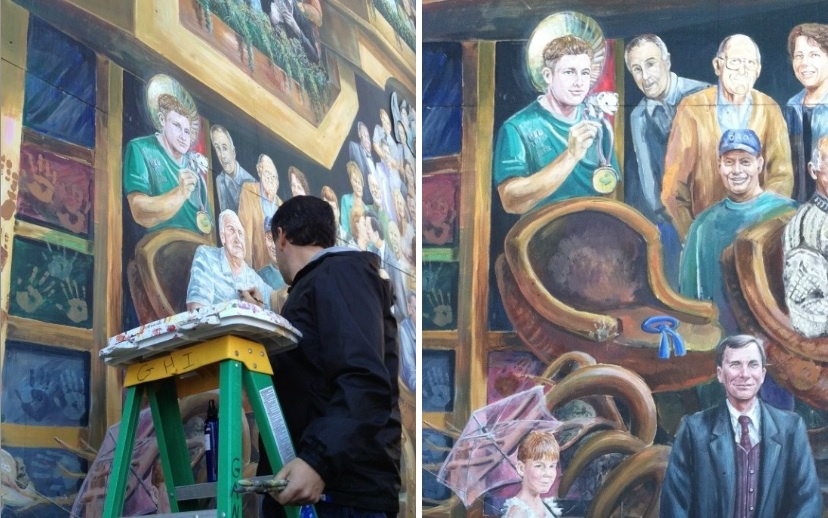
    Sandusky image removed from university mural

    A series of harassment allegations has also reached the U.S. national swimming team. Last week, six more athletes filed lawsuits against USA Swimming, claiming that the federation’s leadership knew about the abuse by former coaches and did nothing to stop them. The swimmers said they had experienced harassment from Mitch Ivey and Everett Uchiyama — both already removed by the federation but still free — and from Andrew King, who is currently serving a prison sentence for pedophilia. Suzette Moran stated that the abuse by Ivey began when she was 12, and shortly before the 1984 Olympic trials, the 17-year-old Suzette became pregnant by her coach, who forced her to have an abortion. Years of rape led to depression, panic attacks, and destroyed her love for swimming. Earlier, coach Sean Hutchison received a lifetime ban from USA Swimming after being accused of harassment by world champion Ariana Kukors Smith.

    Although American cases often become the most high-profile and make global headlines, the problem is by no means limited to the United States. Shortly after the first public statements about Nassar’s abuse, the issue of child sexual violence emerged in British football. The scenario was the same: it had been happening for a long time, at least since the 1970s. Thanks to the large number of people who came forward to tell the truth, within a year and a half 300 coaches and scouts suspected of abuse were identified across 340 football clubs in the country. In total, 12 people were imprisoned. Michael Carson committed suicide before his trial began.

    New accusations were brought against coach Barry Bennell, who worked with youth teams at Crewe Alexandra and Manchester City and had already served three prison terms in the United States and the United Kingdom for raping minors. Colleagues called him a “star maker” and admired his ability to spot potential football talents. Bennell, meanwhile, exploited the dreams of young players, promising that “relationships” with him would help their careers. More than a hundred boys suffered from his abuse.

    Continuing with football: last year, FIFA permanently banned the president of the Afghanistan Football Federation, Keramuddin Karim, from all football-related activities. This was due to sexual harassment, physical violence, and threats against members of the women’s national team — in addition to the already deeply negative societal attitudes toward women who play football. Many athletes were afraid to speak out about what was happening, as extramarital sexual contact in Afghanistan can be punishable by death. Moreover, Karim threatened to kill their relatives and spread rumors that they were lesbians, which is also extremely dangerous in that country. The athletes reported the abuse anonymously to The Guardian, fearing for their families’ safety. They also said that Karim had a secret room at the federation’s training base where he lured female players, and which could only be opened with his fingerprints.

    Heads also rolled in figure skating — particularly in the French national team. At the end of last year, suspicions arose that world championship medalist Morgan Ciprès had harassed a minor skater who trained on the same rink. The girl and her parents said that the French skater sent her photos of his penis (according to USA Today journalists who reviewed the messages, the photos came from Ciprès’s verified Instagram account), while coaches John Zimmerman and Silvia Fontana intimidated the girl, urging her to stay silent because Ciprès and his partner Vanessa James were preparing for the Olympics. They also blamed the victim, saying she was “a pretty girl, and men have needs.” Moreover, the girl’s parents said that another coach, Vinny Dispenza, forced her and another student to message Ciprès asking him to send intimate photos in exchange for pizza from Dispenza himself.

    The scandal also led to the resignation of Didier Gailhaguet, the controversial president of the French Figure Skating Federation, who had previously been involved in corruption scandals. Gailhaguet called Ciprès’s actions “stupid” and later resigned over his own misconduct. It later emerged that Gailhaguet had for years covered up sexual abuse by coach Gilles Beyer. Among Beyer’s victims were Hélène Godard and world championship medalist Sarah Abitbol, who wrote about the abuse in her autobiography. Both were minors at the time.

    Last year, after a wave of reports about numerous cases of abuse — especially in short track — South Korea launched a large-scale investigation into sexual harassment in sports. Two-time Olympic champion Shim Suk-hee and several other short track skaters accused Cho Jae-beom and other coaches of sexual and physical violence. Cho was sentenced to 18 months in prison for assaulting Shim but denies the rape allegations. “If I criticize my coach, my career is over. If I accuse him of crimes, I won’t get into university or a professional team. That’s how it works,” an anonymous athlete explained in an interview with CNN. Olympic short track champion Lim Hyo-jun was found guilty of sexual harassment, and a month ago, Olympic judo silver medalist Wang Ki-chun was arrested.

    And what about Ukraine? For a long time, it seemed that there was complete silence about sexual harassment in Ukrainian sports. Yet a significant — if grim — step forward came with a recent scandal in the climbing federation. Not because it was positive, of course, but because people finally began to speak publicly, pointing out problems and naming those responsible.

    Last year, climber Pavlo Vekla stated that when he was a minor, he had been harassed for years by his coach Artur Pechiy. “In Germany, children are taught in school what pedophilia is. And if there’s even the slightest hint — they go to their parents and file a police report,” said Pavlo, who now lives in Germany. “Unfortunately, in Ukraine, it’s different. I only learned the word many years later, when I was already at university.”

    At the beginning of 2020, Vekla was supported by his teammates — seven athletes, including team leaders Danyil Boldyrev and Yevheniia Kazbekova. They collected testimonies[14] in which they described in detail their experiences working with the coach and succeeded in having him fully dismissed from the federation, where he had remained vice president and continued coaching even after his official suspension from coaching activities.

    Pechiy’s students experienced psychological abuse, blackmail, restrictions on personal life, extortion, inappropriate training loads, and neglect of safety regulations that led to injuries. According to Fedir Samoilov, Pechiy massaged boys and touched their genitals “because it was more convenient for him,” or “inserted a finger into their anus.” He also “asked the boys ten times a day when and how often they masturbated,” gave them advice on how to do it, and described how he did it himself. Samoilov had previously supported the coach but changed his opinion after re-evaluating his experience and publicly apologized to Pavlo Vekla.

    Climbers had reported Pechiy’s behavior to the coaching council earlier — back in 2013 — but according to Vekla, “they were only laughed at.” Pechiy himself, predictably, called it all lies and a publicity stunt and filed a counterclaim.


    After all these stories, it may seem that sport is an all-powerful evil and a source of inevitable danger. The problem is indeed far from being solved: such a deeply entrenched system is difficult to dismantle in a year or even several years, no matter how powerful the effect of these sporting “Weinsteins.” Moreover, trust in law enforcement remains weak, and not all parts of society are mature enough to discuss and take this issue seriously.

    However, it is important that — however slowly — we are beginning not only to see this problem but also to understand and respond to it. The only way to protect ourselves and our children who play sports is to speak out. Speak about our own experiences, speak about the experiences of others. Overcome discomfort and talk to children about their bodies. Overcome fear and shame and talk about the violence we have experienced or witnessed. Support the broad implementation of sexual education in society.

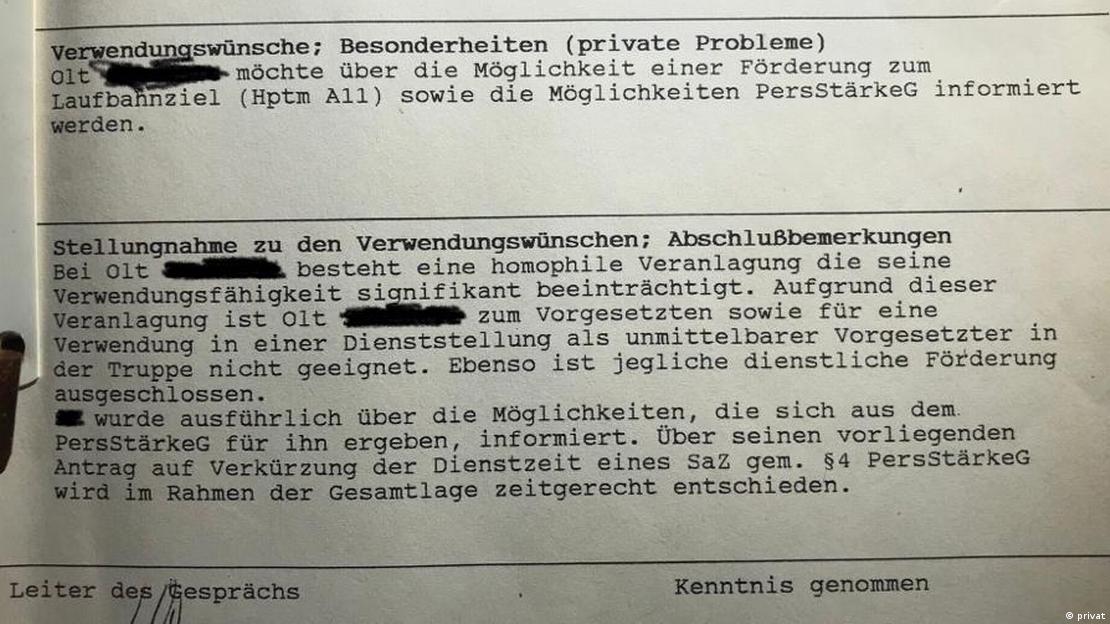
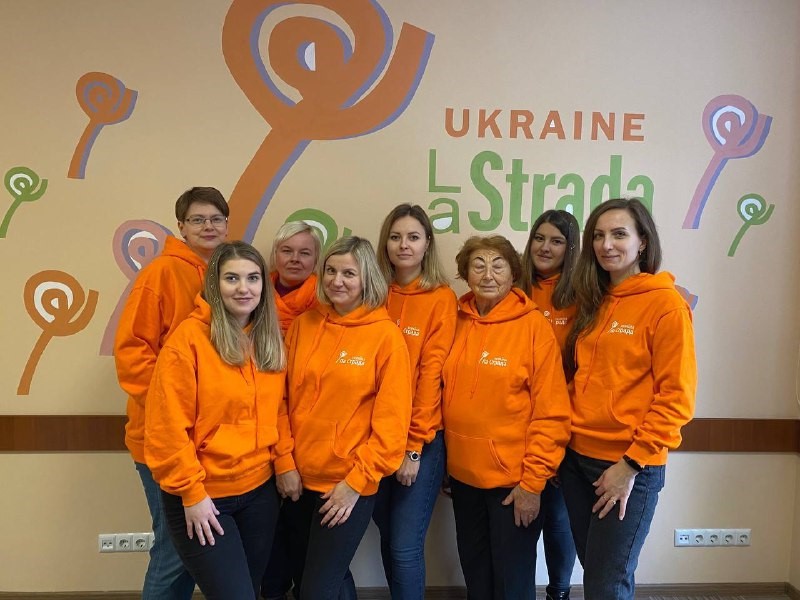
    Ukraine does not yet have its own equivalent of SafeSport, but regardless of the field in which violence occurs, you can contact the police or civil society organizations specializing in this issue, such as La Strada Ukraine.

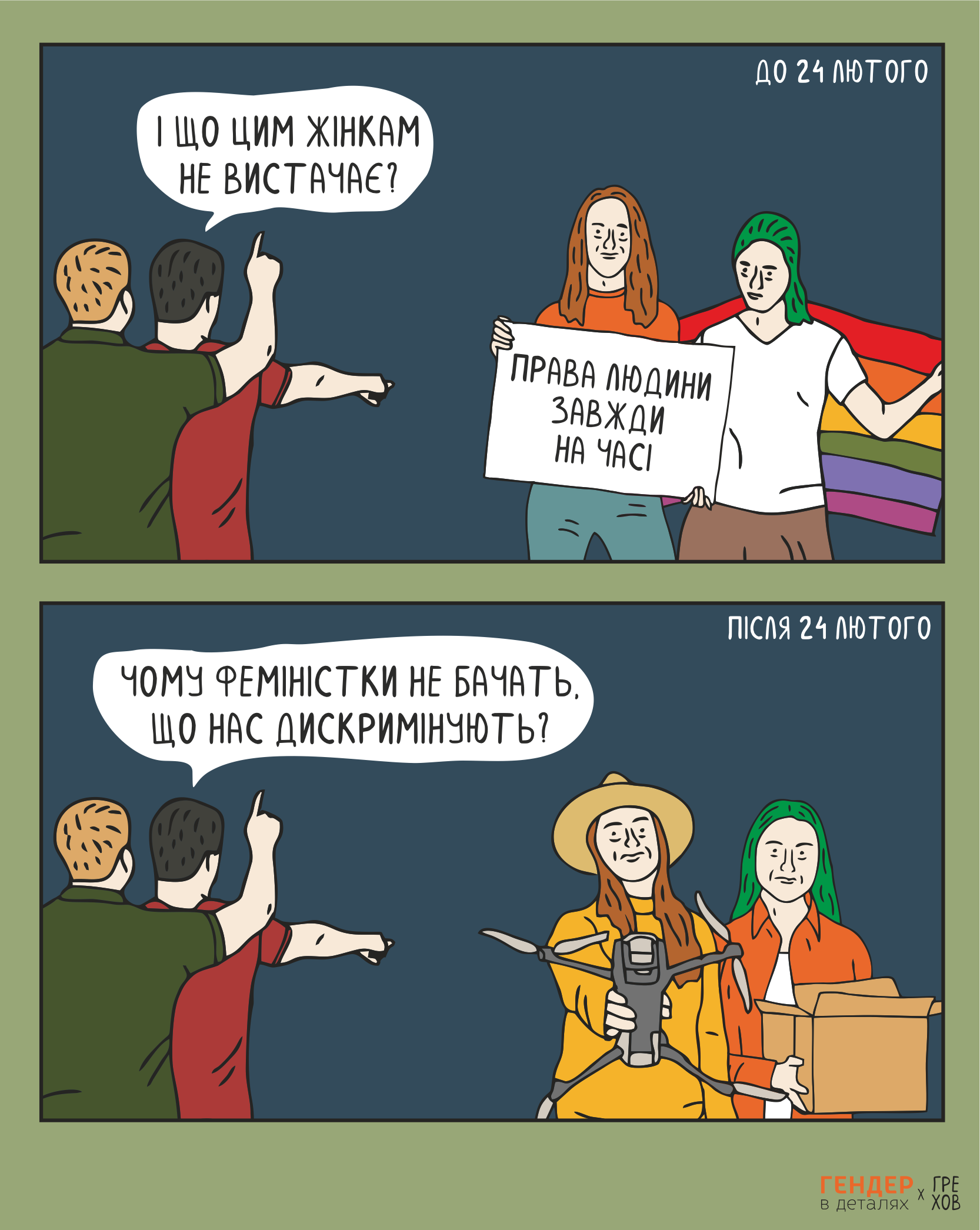
  • Why do feminists “cripple” language with feminatives?

    Why do feminists “cripple” language with feminatives?

    “‘A female journalist’ on a business card? You must be joking.”

    Leonid Petrovych used to say I would lose my job before anyone printed the feminine form of “journalist” on my business cards. “Those kinds of business cards simply don’t exist,” he insisted.

    One day, I was handed a stack of cards that identified me using the masculine form of the profession. I spent half the night adding the feminine ending by hand to every single one.

    Leonid Petrovych was my editor ten years ago. An old Soviet-trained philologist, he addressed forty-year-old women journalists as “girls” and assigned them stories about cooking and health, even when they were accomplished professionals who understood economics and finance far better than he ever had. “Beauty is your greatest weapon,” he liked to say in his International Women’s Day toasts, before making his way around the room with unwanted hugs and oily compliments.

    Whenever we argued about language, he would pull out an old dictionary, open it to the word “journalist,” and triumphantly point out that only the masculine form existed in print.

    “Exactly!” I would reply. “I exist, but the word for me doesn’t?”

    Ten years ago, fighting for feminine professional titles in Ukrainian was very different from what it is today. I argued with editors over the right to write “female director” rather than using the masculine form. Sometimes I even argued with women leaders themselves, because many considered feminine titles insulting or diminishing.

    People who disagree with me about feminine professional titles often see this as a purely linguistic debate. For me, it never was. It is not stubbornness for its own sake, nor a passing trend. It is about visibility.

    If I exist, there should be a word that names me.

    In Ukrainian, nouns have grammatical gender. The word journalist is grammatically masculine. I do not call myself by the masculine form because my language contains a word that accurately reflects who I am.

    Not so long ago, women were excluded from voting, higher education, and public life. There were no women journalists to name because women were largely absent from those professions. Yet there were feminine words for “cook,” “maid,” or “mistress.” Interestingly, defenders of linguistic tradition rarely object to those forms.

    I find it difficult to accept a language in which I can be a “maid” or a “waitress,” but not a “director,” a “doctor,” or a “philosopher” in the feminine form. If people are comfortable with feminine titles for lower-status occupations, they should be equally comfortable with feminine titles for positions of expertise and authority.

    A decade has passed since my battles with Leonid Petrovych. Today, I work in television news. Women are identified in our on-screen captions using feminine professional titles. In my country, there are not only ministers, but women ministers whose titles are written in the feminine form. Ukraine’s updated orthography officially recognizes these forms, making them a standard part of modern Ukrainian.

    That is why I was surprised when, only a few weeks ago, a website I wrote book reviews for systematically removed feminine titles from my texts. “Author” in the feminine form became the masculine “author.” “Woman writer” became simply “writer” in the masculine form.

    When I asked why, the editor—a young man—explained:

    “Feminine professional titles don’t fit the style of our publication.”

    Looking through the website, however, I noticed that the publication had no problem with words such as “actress,” “singer,” or “stripper.” What they objected to were feminine titles associated with expertise, authority, and intellectual work. After I challenged the decision, my article disappeared from the website altogether.

    Perhaps that editor drinks lavender lattes, flies to Italy for holidays, and gets his hair cut in fashionable barbershops. Yet every time I think of him, I see Leonid Petrovych’s face.

    Was I upset? Only a little.

    Because feminine professional titles are now a legitimate and inseparable part of the Ukrainian language. They are increasingly common in the media, in public life, and among younger generations. For many Ukrainians, they are simply the most natural way to refer to women’s professions.

    And, by the way, my business cards now say “journalist” in the feminine form.

    Just like the business cards of all my friends working at respected media outlets.

    No, Leonid Petrovych, I am not joking.

  • What you need to know about gender when you’re 13

    What you need to know about gender when you’re 13

    Do you remember how girls and boys dressed up for New Year’s celebrations in kindergarten? It was usually something like “snowflake girls” and “bunny boys.” Year after year, the same pattern repeated itself.

    And what was your favourite toy? Mine was a doll named Liubashka. In fact, dolls were almost the only gifts I ever received—always with long hair and pink dresses. Now let’s take a look at whether gender stereotypes had anything to do with that.

    Gender and Sex Are Different Things

    The concepts of sex and gender have both similarities and differences. Both are characteristics of a person. The key distinction is that sex is not unique to humans—it also applies to animals (such as birds and fish) and plants. Flowers and cats, however, do not have gender characteristics.

    So, sex is a biological characteristic. It refers to the physical sex traits a person is born with. Most newborns are classified as either male or female. There is, however, a third possibility, which is much less common: being intersex. This does not mean that a person possesses all the characteristics of both sexes. Intersex people may have a range of traits that differ from the two typical sex categories, such as variations in sex chromosomes, hormone levels, or reproductive anatomy.

    Some chromosomal variations may not be visible externally, and intersex traits can sometimes only be identified through specific medical testing. According to the World Health Organization, intersex people make up between 0.5% and 1.7% of the global population.

    Gender, on the other hand, is a social and cultural concept. It refers to the traits and characteristics that society expects people to have based on their sex. For example, in Ukrainian culture, women are often expected to be caring, emotional, and compassionate, while men are expected to be resilient, tough, and reserved.

    It is important to understand that social expectations are not always fair. You should not feel pressured to reshape yourself simply to meet the expectations of parents, friends, teachers, or anyone else. It is far better to be the person you feel comfortable being. There is nothing wrong with a boy being gentle and affectionate, or with a girl being the opposite.

    “Real” Men and Women Exist Only in Stereotypes

    The standard set of qualities associated with “real” women and “real” men begins to take shape in a child’s mind from a very early age.

    For example, when a kindergarten teacher scolds girls for being naughty and playing supposedly “boys’” games (racing, shooting games, etc.). In fact, there is no official division into “boys’” and “girls’” games, these are all gender stereotypes.

    The same story continues at school, when the teacher, checking the notebooks, notes that “Marina’s handwriting is terrible, like a boy’s.” Thus, the teacher draws attention to the fact that girls should be neater, more responsible in terms of their studies, according to the gender stereotype.

    And when it comes to a school discipline like “Labor Training,” the situation is even stranger. No matter how much the school administration wants it, not all girls like to cook and cross-stitch, just as not all boys like to repair furniture. Let’s not forget that this is an education system that has been formed over decades. Recently, division of labor in lessons was made optional, but it is difficult for schools to quickly change approaches. If studying the basics of sewing, cooking, or making metal parts makes you uncomfortable, we advise you, preferably together with your parents, to agree with the school administration or teacher about finding alternative activities, such as origami or papier-mâché.

    The school uniform also limits the possibility of self-expression, because, according to the established school rules (which, however, may differ in different schools), girls must wear skirts and blouses, and boys – business suits. To feel comfortable and convenient in this uniform, you should approach the choice of clothes very responsibly. The skirt can be replaced with business trousers (of course, after discussing this issue with your parents and class teacher), complement the image with stylish shirts and blouses of various shades that will correspond to the official style. Similarly, a business suit for boys can go beyond black trousers and a white shirt, although it must still correspond to the established dress code.

    Gender Roles

    You wake up in the morning – you are a daughter or a son, you go to school – you are a student, you stop by the store on the way – you are a shopper, in the evening you go for a walk with friends – you are a friend or a girlfriend. All of these and much more are gender roles that you fulfill every day.

    Think of typical math problem conditions: “to make borscht, mom bought 3 carrots, 2 beets, and 10 potatoes at the store,” and “dad used 7 rolls of wallpaper and 3 buckets of paint during the renovation.” Even here, a clear division of gender roles can be traced. The mother is a housewife who constantly cooks, cleans, helps with homework, and meets the father from work. In turn, the father’s main mission is to support the family, protect it, and solve complex household problems.

    In fact, this is not a “norm” or an obligation. Your grandparents, mom, and dad were probably raised with this idea of ​​ideal family relationships. Maybe your mom and dad agreed on this division of responsibilities because it’s just convenient for them. Or maybe things are different in your family?

    There are families where the husband takes maternity leave and the wife continues to work. And she works, for example, as a locksmith. There are families where both parents do the housework equally. And this is also absolutely normal. The main thing is that all family members feel comfortable in such conditions.

    So, for example, you should not judge girls who play soccer and boys who do ballroom dancing. You should also not laugh at men who do so-called “women’s” work, and vice versa. You should not limit yourself or anyone else in his or her preferences.

    On growing up, self-acceptance, and personal boundaries

    The period from 10 to 20 years is sometimes called the “decade of change.” This is because up to 10 years old, children — both boys and girls — develop physically in approximately the same way: they are almost the same height and have an identical body structure. After 10 years old, a pubertal growth spurt occurs, and a child, already almost a teenager, can grow by 7–12 centimeters per year. Girls at this age usually surpass their male peers in height and development. In girls, the leap occurs on average at 10–11 years of age, in boys at 13 years of age.

    With the onset of puberty, girls’ pelvis expands, hips and buttocks noticeably round, breasts enlarge, and hair begins to grow in intimate areas and armpits.

    The first menstruation occurs between the ages of 9 and 15, most often at 12–14. By the way, you should not be afraid of this, you should just be prepared for it – have individual means for critical days (pads), wet and dry wipes, and painkillers if necessary. Yes, sometimes menstruation can be somewhat painful – it can “pull” the back and lower abdomen.

    The first year (or a little more) the cycle may be irregular – usually from 22 to 34 days. A full menstrual cycle is also characterized by the presence of ovulation. Ovulation is a phenomenon in which an egg cell comes out of the follicle. Then the egg cell comes out of the ovary and is picked up by the fallopian tube. After which the egg cell gradually moves along the fallopian tube and if it meets a sperm cell on the way, fertilization will occur and the process of embryo formation will start. After the first menstruation, it is advisable to consult a gynecologist, because certain changes have occurred in the body: you have grown up, become a girl, therefore, from the moment of ovulation, after sexual contact you can get pregnant.

    Physiological and psychological changes that occur in adolescence are naturally manifested through increased interest in sex, in books and films on this topic, in the opposite sex, high sexual arousal, masturbation. This is normal for both boys and girls.

    Physical changes can catch teenagers by surprise, upset them, or scare them. A boy’s physique takes on typical masculine features: his shoulders become broader, his hips narrower, and his chest and back muscles become more prominent. There may even be temporary (!) swelling of the mammary glands and nipples. As a boy grows up and becomes a teenager, he experiences his first ejaculations—involuntary ejaculation of semen during sleep at night and in the morning, often accompanied by erotic dreams. Boys often perceive this process as a disease and are very worried, but this is absolutely normal.

    You are growing, and it is normal that your weight may be higher or lower than that of your friends. We advise you not to limit yourself in food, but to exercise and maintain water balance. Sometimes thirst can be confused with hunger. It is better to replace “harmful” food with healthy ones: during a break at school, snack on a vegetable salad with a cutlet, rather than chips or burgers, and in the evening, sitting in front of the TV, it is better to eat sliced ​​​​fruit, rather than a kilogram of ice cream.

    There may be some skin problems – rashes and acne (blackheads). Both girls and boys can seek advice from a nutritionist and dermatologist, visit a beautician. An important element in the fight against rashes is skin care at home: cleansing, toning, moisturizing. There is nothing funny or shameful in the fact that a guy will use masks and face creams, because self-respect and taking care of his body do not depend on gender.

    It is at this age that a choice arises: to be ashamed of yourself (to have complexes, to go on diets, to hide your body under larger clothes, to cover up skin rashes with foundation) or to accept yourself with all the features (yes, the features, not the flaws!) of your body. Accepting your body as it is (regardless of weight, skin and hair color, leg length, scars or congenital defects) is called body positivity. The slogan of this movement is “My body is my business.”

    By the way, about the body and business. It is important to build clear personal boundaries. As you were explained in childhood, no one can touch you if you are uncomfortable. This is from the category: “Go fuck your grandmother, she hasn’t seen you for so long!” – and you don’t want to kiss her at all, and there may be various reasons for this.

    In such cases, you need to correctly (!) explain why you don’t want to. Your parents and grandmother may be offended, but this is your personal space, and they must accept it one way or another. Try to talk (talk, not argue) and explain your position, then your parents will definitely go to your aid, understand and support you, because you are no longer a small child, but a person who has the right to choose who and when to “slap” (well, as an example).

    Resources for teenagers (and not only) about sex education and growing up:

    TikTok:

    @serhiyfrolov — advice and answers to questions from an obstetrician-gynecologist about women’s intimate health

    @ecowoman — “non-Gynecologist about sex education” for girls and boys

    Instagram:

    @gendeindetail — about gender identity and feminism

    @vpershe — media about sex education for young people

    @gender.z — about the diversity of gender relations, LGBT+ and equal rights

    @uaspec.network — a blog about asexuality and aromanticism

    @teenergizer — a resource for teenagers about HIV/AIDS, sex education, psychological support, activism

    @podcast11a — a podcast for teenagers about sex and relationships with yourself and others

    Maybe you know some other cool blogs? Write to us on Instagram @gendeindetail!

  • Violence that is usually ignored in Ukrainian literature

    Violence that is usually ignored in Ukrainian literature

    Around the time when public torture and executions in the West were gradually losing their popularity (not among the common people, of course, but among those in power who set the tone) and giving way to closed trials and imprisonment, a new Ukrainian literature was emerging. Declaredly oriented toward the mass reader and popular format, it serves as an encyclopedia of social moods and customs. With one important caveat: sometimes these moods and customs are products of the populist imagination of the intelligentsia — invented first, and only then offered to the reader.

    Literature in the Service of Ideology

    Frankly, this remains true to this day — the only difference being that the position of that part of the cultural sphere which “strays from the path” and strives to create primarily “art for art’s sake,” and only secondarily to influence the value system of ordinary citizens, has been gaining strength.

    However, aesthetic progressiveness in literature does not automatically translate into the promotion of democratic values and the principles of gender equality and tolerance. Even the classics sometimes contain things that are appalling by today’s standards. And our contemporaries also often cross the line of established norms of ethics and democracy. The boundary between public accountability and censorship is, in fact, quite thin. We may raise our voices around the most outrageous cases — but we should not aggressively overuse this approach. Neurotic self-censorship among the most vulnerable artists is hardly the goal of feminist critique.

    A civilized discussion of what, from the standpoint of basic values, requires a new approach — and the marking of gross violations of equality, human rights, and freedoms — appears to be the most effective tool in the long run.

    There is much to work on. For instance, Ukrainian literature of the past two centuries abounds with violence of all kinds and scales. We are used to thinking of our culture as patriarchal, yet it is simultaneously filled with images of flower-like girls, gentle and unhappy maids, and courageous, noble — though often equally unfortunate — men. Serfdom was abolished long ago, which means the path to happiness for the heroine of Ukrainian classics seems shorter now: all she has to do is escape the village stove, get an education, find paid work, and secure “a room of her own” — and, ideally, avoid drowning herself in despair over unrequited love or an unwanted pregnancy.

    If you think that’s all there is to it, you’re underestimating Ukrainian literature — and its role. In a literature-centered culture, the influence of popular texts is enormous. Those in power — both the deeply concerned moral majority of the community or nation, which guards ethical values, and those who shape domestic policy — know this and seek to keep it under control.

    Traditionally, the origins of modern Ukrainian literature are traced back to Eneida by Ivan Kotliarevsky. Such a cheerful poem — where could there possibly be violence? Here, for instance, Aeneas begins an affair with the queen Dido, starved for male affection: joy, adventure, eroticism — everyone’s happy. But as soon as the “brisk young man” sets off toward his destined goal, the widow immediately commits self-immolation.

    Flames blazed all around her,
    The dead woman was no longer seen,
    Smoke and fumes rose from her pyre! —
    So deeply did Dido love Aeneas
    That she burned herself alive
    And sent her soul straight to hell.

    Thus, she herself becomes the object of condemnation — and, being the source of power in her own kingdom, she also becomes the one who punishes herself for violating the unwritten law of adultery: she betrayed the memory of her dead husband and surrendered to a foreign prince. The worst part is not even that she will be condemned — it’s that she will be ridiculed. The moral violence of public judgment still lies ahead, but the queen chooses not to live to face it. Or rather, the author chooses to tell us the story this way — for he would like widows who have found comfort to end just so.

    And what about Aeneas?

    Though he hurried to sail away from Dido,
    He wept bitterly, inconsolably.
    And when he heard she’d burned in the fire,
    He said: “May she have eternal glory,
    And may I have long-lasting power,
    And soon find another widow too!”

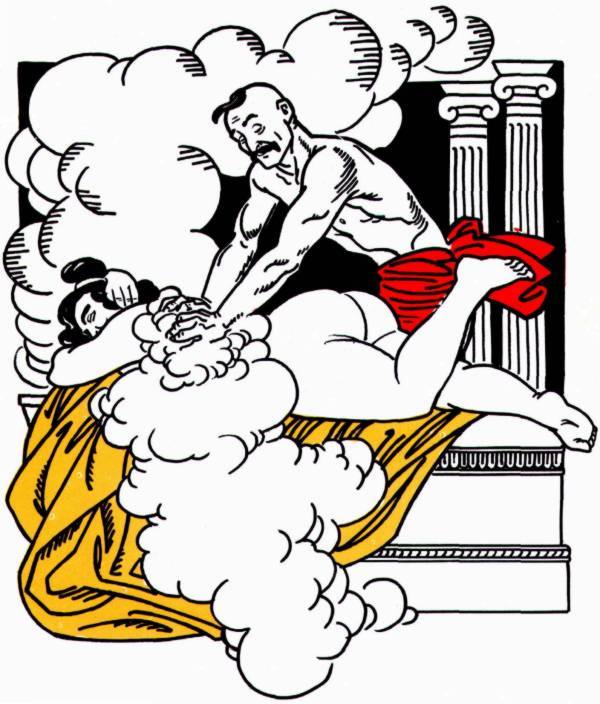
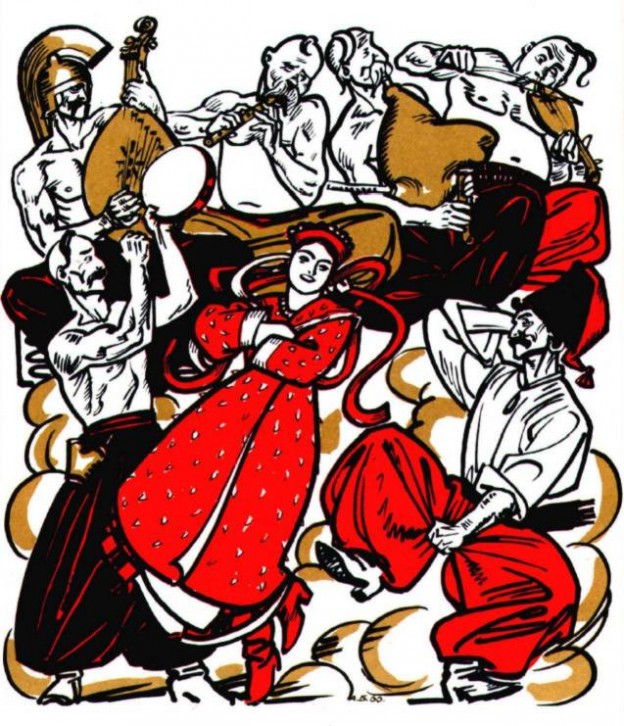
    “Aeneid”, illustrated by Anatoly Bazylevich, 1968

    But the “fallen woman” Kateryna — the most famous heroine of Taras Shevchenko — actually lived to see public condemnation. And she must have regretted it a thousand times: when her parents cast her out of the house (“Had I known, I would’ve drowned myself before sunrise,” her mother says in farewell, advising her to look for a mother-in-law in Moscow), when she wandered with her child, begging for food. Eventually, Kateryna meets her unfaithful lover again, but he wants neither her nor their son. The heroine drowns herself in grief, and the child, growing up as a beggar, later becomes a blind minstrel’s guide.

    Shevchenko writes about Kateryna with compassion and tenderness — he truly pities her. The poem remains wildly popular even today: countless readers and listeners have wept over it in every Ukrainian home; now it is recited at cultural centers during commemorative events. Yet no one ever defends the girl’s right to raise an illegitimate child. It is worth noting that in reality, not all “fallen women” shared Kateryna’s tragic fate — yet classical literature has cemented precisely this image as typical.

    In schools, the traditional reading of this sentimental story is still used for moral instruction: Kateryna is condemned for her recklessness and naivety, while her tragic end evokes sympathy. The seducer is a clearly negative figure — that point is never debated. But the parents’ actions remain unquestioned: as captives of harsh folk morality, they simply “couldn’t do otherwise.” A lesson on Kateryna could become an opportunity for an open conversation between teachers and students about the evolution of moral and ethical norms and sanctions — after all, two centuries have passed since Shevchenko’s time!

    And of course, Kateryna is a Ukrainian girl — one of “our own.” But non-Ukrainian women fare even worse: they become objects of revenge, forced to atone through suffering for the sins of all oppressors of the Ukrainian people — and their children, too. The scene of infanticide in the poem Haidamaky is shocking: Honta publicly slaughters his own sons because they are Catholics, like their mother. National identity comes second, as do paternal feelings. The children stammer, “We are not Poles.” Later, under cover of night, Honta buries them according to Cossack custom — yet he must remain loyal to his oath and kill the little “Catholics” with a consecrated knife.

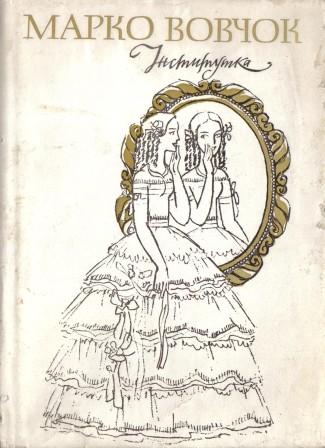
    No one describes a woman’s cruelty toward another woman as truthfully as a woman herself. Mariia Vilinska — an emancipated writer who told stories of young women leaving their parents’ homes, earning their own living instead of perishing, and later marrying for love by their own choice — began her literary career with Ukrainian-language Folk Tales under the pen name Marko Vovchok. There she outshone everyone in depicting the brutal life of female serfs. Sadistic masters and mistresses prick their maids with needles, crush their hopes for love and marriage, scold, and beat them.

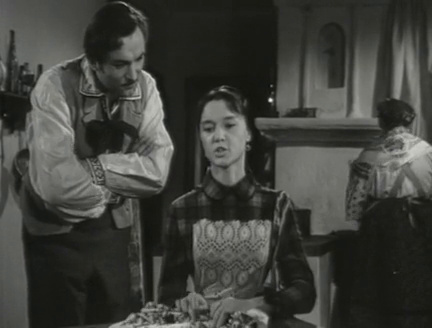
    From the school curriculum, we remember Horpyna: a serf mother so overworked that she doses her baby with poppy extract to keep it quiet — and the child dies. The mother has no right to rest, no medical help, no shred of compassion from her enslavers. The culmination of this period in the writer’s work is undoubtedly The Boarding School Girl (Instytutka).

    Violence inflicted by a woman upon another woman — or upon a man, or her subordinates — appears unnatural and tragic, more repulsive even than that committed by men. The educated young lady in The Boarding School Girl ostensibly pursues a noble goal — to reform and “optimize” the management of her estate:

    “…she found hard work and bitter misery for everyone. The crippled and the children, even the tiniest ones, were not spared. The children swept the gardens, herded turkeys; the cripples sat in the vegetable patch, scaring away sparrows and other birds.”

    She has also learned well that the serfs are her property, her enslaved labor force — and that she not only can but must train and beat them:

    “At first she would only pinch or push lightly… and then blush like fire, ashamed of herself. But once she got used to it, settled in — that’s when we truly learned where in this world evil lives.”

    The cruelty reaches its climax:

    “I looked at her — she had become so terrifying my legs gave way. She grabbed me by the neck with both hands! Her hands were cold as snakes. I tried to scream, but the breath was knocked out of me — I fell by the apple tree and came to only after being splashed with cold water.”

    The writer leads the reader to the conclusion that the problem lies not in the inhumanity of one individual, but in a social order that itself requires reform.

    The drama of society is best illustrated through the example of the family. Ivan Nechui-Levytsky’s The Kaidash Family — seemingly comic — is, on closer inspection, deeply tragic: it depicts a struggle among several women for power within a single household. The men try to stay out of these domestic quarrels and instead divide the world into female and male spheres. The house belongs to the women, who literally divide the shared space — sweeping their respective halves of the entryway in turns. The distaff becomes a symbol of domination: both the mother-in-law and the daughter-in-law need it, and rather than obtaining another, they fight over it, ending in a physical scuffle.

    Nechui-Levytsky loved to converse with ordinary women “from the people,” observing their speech and behavior. In his depictions of the Kaidash family, as well as of old women like Baba Paraska and Baba Palazhka, we see the fruits of these observations — vivid sketches “from life.”

    It is evident that under different circumstances, an intelligent, strong-willed, and passionate woman could have achieved far more than victory over her mother-in-law. Even the marriage of two equally strong personalities — Karpo and Motria — could have been a partnership of potential rather than conflict. Yet, confined within the domestic space, the family, and the village, these women gossip, scheme, reproach their husbands, and draw them into their local battles.

    A few decades after Shevchenko’s Kateryna, male moralizing resurfaces in Panas Myrny’s The Loose Woman (Повія). This Ukrainian “sister of Carrie” (written several years before Dreiser’s Sister Carrie) reveals the author’s clear intent to punish a woman who dared defy social morality. Khrystya Prytyka escapes her village for the city, first becoming a maid, then the mistress of a wealthy man. After her lover’s death, she is forced into prostitution, ending in humiliation, disease, and death. The scene in which Khrystya’s nose falls off deserves a place among the most horrifying moments in Ukrainian literature.

    The stories of Khrystya’s friends are no less shocking. For instance, Mar’ya recounts how a landowner raped her, kept her chained for resisting him, and how, after escaping, she lived with another gentleman who blackmailed the first for money in exchange for silence — only to keep most of it for himself. When Mar’ya became pregnant, he neither wanted the child nor marriage:

    “…the next day he came home from work with a little bottle. Something yellow, almost red, inside. ‘Here,’ he said, ‘drink it — it’s just wine.’ I didn’t know anything, of course, so I drank it. At first — nothing; I even had lunch. Then I started to tidy up, and suddenly the pain struck — sharp, unbearable. My eyes went dark. I fell and remembered nothing. When I woke up, I was lying in a pool of blood… such a puddle! My heart hurt so much… I wished I’d died right there. But he stood over me: ‘Clean it up,’ he said, ‘and bury it in the garden.’ I couldn’t bear it — ‘Clean it yourself, if you caused it!’ Then he stomped his feet: ‘I’ll throw you out on the street! I’ll show you!’ So I gathered it all in a broken bowl, waited for evening, and buried it in the garden.”

    Later, the girl was imprisoned and sent to a convent — punishment for her “crime.”

    Panas Myrny does not condemn his heroines or their thinking — he condemns the social order that gives peasant girls, many born into serfdom, so few options. Was Myrny a proto-feminist? Undoubtedly yes — as is every author who sympathizes with the oppressed. In his other works, he shows the same empathy toward men: for him, the root of human tragedy lies in class position, poverty, limited opportunities, and low social mobility — the real sources of suffering.

    The consciousness of these unfortunate heroines is quite simple: they are uneducated, accept suffering as fate, believe it impossible to resist, are unaware of their rights, and their dreams of the future are limited in imagination. It is Panas Myrny who understands that beating and rape are wrong; his ill-fated heroines — Khrystia, Mar’ya, Maryna — like those of Marko Vovchok and Taras Shevchenko, can only hope that in the next episode, luck might finally favor them.

    It would be difficult to accuse Ivan Franko of violating women’s rights. Yet his feminism is but a natural extension of his socialist worldview — and nothing more. Recall his backhanded compliment to young Lesia Ukrainka: “This sickly, frail girl is perhaps the only real man in all of modern Ukraine.” Torn from context, this phrase has followed the writer ever since — even after her death.

    Lesia Ukrainka’s works often depict the suffering of those who differ from the dominant majority. In The Forest Song, for instance, both Lukash’s mother and his brisk, red-cheeked peasant wife Kylyna — a woman made for fieldwork and housework — torment the fragile Mavka, who is “not of this world” and capable of something far beyond reaping rye. Instead of finding her a fitting domestic task or simply leaving her in peace, the village women mock the girl for her otherness. The fact that their beloved Lukash loves Mavka is no reason, in their eyes, to accept her into their community.

    A similar pattern appears in Boyarynia (The Noblewoman). Thrust into a foreign society with entirely different customs, the Ukrainian Oksana finds herself unable to survive there: she is far too emancipated for Muscovy. She is shocked to learn of the local tradition — marriages arranged through matchmakers, without courtship or affection. The ritual itself horrifies her:

    “You will bring them a tray of honey,” says her mother, “the lady will arrange it all as required — you bow, and the boyar will kiss you on the lips…”

    At first, Oksana refuses to take part, but her husband Stepan insists:

    “You only need to greet them and return to the women’s quarters.”

    He reasons pragmatically:

    “I never told you there’s freedom here. But if we didn’t bow our backs here, the Muscovite voivodes would have bent our family thrice over back in Ukraine. You faint from disgust that some old man may touch your lips — but when I must call myself ‘Stepka the serf’ and kiss their hands like a slave, is that not worse?”

    Oksana has no choice but to suppress her pride and play along — for the sake of the family’s survival.

    In the end, she dies — crushed by the unbearable weight of social pressure. The domestic comfort of home, even her husband’s support, cannot save her from the suffocating atmosphere around her. (Similarly, Princess Yevpraksiya, the heroine of Pavlo Zahrebelnyi’s novel of the same name, perishes after being married off to a foreign land. We see again how a woman — especially a foreigner, young and inexperienced — remains powerless in a patriarchal world, where noble birth offers only illusory protection.)

    In The Stone Host, Lesia Ukrainka’s drama about Don Juan, the enamored Dolores sacrifices herself to atone for his sins, while the widow Donna Anna must remain faithful to the husband Don Juan has slain. Yet the Commander’s statue punishes the seducer, not the “unfaithful” woman: woman here remains an object, a possession. Slaves are punished only when they begin to think for themselves — when they cease to be slaves.

    When it comes to war, violence reveals itself most starkly.

    Woman is, traditionally, the unprotected being. And if there is an opportunity to access her body without consequence — it is usually taken. Does Valerian Pidmohylny condemn the rapist in his story The Third Revolution? After yet another anarchist raid, “in a corner of the bourgeois house, Ksyana lay sprawled, her head thrown back, her knees bent — a grotesque heap of violated flesh.” Earlier that day, she had planned to surrender herself willingly to Makhno himself. Pidmohylny’s disgust is evident.

    But does he condemn his protagonist Stepan Radchenko, when Stepan rapes Nadiyka? The answer is less clear. Stepan is intelligent, strong, ambitious — a charismatic scoundrel. His brilliance and promise seem to eclipse his crime. Readers — and even critics — often forgive him in silence, focusing instead on his rise in The City, as if the assault were a minor footnote on his path to success.

    If Pidmohylny, Khvylovy, and Yanovskyi treat violence in the Civil War with moral anguish — feeling it as both personal and collective trauma — then later, in canonical works about World War II, the tone changes. Soviet authors, though ostensibly humanist, always know exactly how things “should” happen and how readers should feel about them.

    Oleksandr Dovzhenko’s Ukraine in Flames is a prime example of male fantasy disguised as patriotic tragedy. Olesia gives herself to the first passing soldier — to ensure that she is deflowered by a Ukrainian, not a German — and then remains eternally faithful to Vasyl Kravchyna, whom she may never see again. Her friend Khrystia, however, makes no such gesture (perhaps the idea simply never occurs to her?). She becomes the lover of an occupier — though an Italian, not a German — and perhaps for that reason, the author ultimately forgives her, but only after forcing her to repent with the same intensity as Shevchenko’s Kateryna.

    And indeed, portraying a woman as an object of violation is a perfect tool of propaganda meant to stir aggression in the humiliated male who is convinced that this woman, left on occupied territory, belongs to him.

    Yet things are no better for women at the front. In Oles Honchar’s “The Standard-Bearers,” Shura Yasnohorska is the darling of the entire regiment—so much so that when her fiancé is killed and she later falls in love with another man, the brotherhood at the front must approve her choice (recall Dido and Donna Anna!).

    Later, Oles Honchar would write “The Cathedral,” where Yelka, raped by a village brigade leader, is tormented by the loss of her “honor.” It then becomes clear that the problem exists only in Yelka’s own mind. She need not repent, nor keep silent; rather, she should not fear publicly naming the unworthy act of another woman’s husband.

    Marusia Churai: a woman, a killer, an artist

    It is difficult to name a male Ukrainian writer who has portrayed a woman-killer as a sympathetic heroine—not merely attractive or charismatic, but genuinely positive.

    Such is Marusia Churai in Lina Kostenko’s eponymous poem: strong, proud, talented, she did not kill out of baseness. And in any case, she poisoned—she did not stab. A classic, typically feminine method. Yet men judge her without allowances for her sex, and the verdict of the public court is stern and “just,” as expected—public execution. In the end, she is pardoned by a special hetman’s decree, but the broken poet is no longer fit either for creativity or for love.

    Marusia is loved and respected for her “artistic merits”—at the time, typically masculine ones, hence the authorities’ keen attention to her case. What kills the artist in her—society’s attempts at censure, however tinged with sincere sympathy, or her own convictions about a single love for life and a notion of femininity incompatible with killing her beloved with her own hands? Marusia places first the dream of family life with a specific man, and when that dream shatters, all other possible options—from marrying someone else to focusing on her art—prove unacceptable.

    Violence and erotica in the struggle against Sovietness

    The anti-official literature of the last thirty years became a space for experiment and innovation. The performative masculinity of Andrukhovych’s characters, the demonstrative eroticism of Pokalchuk’s and Vynnychuk’s prose, the feminist essays of Yevhenia Kononenko… Descriptions of violence—physical and moral—are scattered generously throughout these texts.

    Authors often resort to this deliberately: such details more easily hook or move the reader—or catch them with “juicy bits,” if we are speaking of mass literature. In men’s prose, erotic scenes became one of the standard devices for creating mass-market fiction (amid the oft-declared shortage of contemporary Ukrainian popular reading) and/or an outrageous means of shattering the prudery of Soviet literary norms.

    Which of these books have become classics? First and foremost, Oksana Zabuzhko’s “Fieldwork in Ukrainian Sex.” Violence here is dissected and meticulously described. Bad sex? It’s there. An attempted rape? Of course. Need a character with a damaged psyche? The father, the lover, the heroine herself, people in her milieu… indeed, everyone. Want something larger in scope? The drama of violence against an entire nation unfolds before you, and the love story of a writer and an artist turns out to be only a pretext.

    Yevhenia Kononenko’s “Without a Man” is a classic of Ukrainian feminist essay writing. The narrator recounts her private biography—from a mother’s and grandmother’s admonitions about the image of a “decent woman” to several romances and matrimonial attempts of various kinds. One man turned out to be impotent; with another, premarital sex was marvelous, but marital sex less so, because “for most men, getting married means buying a live mattress on the cheap”; yet another was fine in everyday life but did not understand the writer’s literary ambitions.

    And then the heroine sighs ironically:

    “A feminist must be married, and happily married. (Happily not in the patriarchal sense—i.e., well provided for—but happily in the sense of established partnership with a beloved man.) This is necessary less in the interest of the feminist herself than of feminism as such. Because the people still perceive feminism as the cry of an under-satisfied female. The people cannot decide which is worse: under-satisfied or over-satisfied.”

    Against this backdrop, Andrukhovych’s earlier alcoholic epic, in which Otto von F. engages in “an unlawful sexual act with a citizen of the Malagasy Republic, Tatnaketea. The poor girl still believes she was visited by Ananmaalhoa—the spirit of fertility, horticulture, and procreation,” and breaks the heart of Halyna K., seems to belong to a different category: too much irony, too little authorial tragedy.

    By contrast, Maria Matios’s prose—beginning with the novella “Yuriana and Dovhopol”—is an expressionist portrayal of Ukrainian (more precisely, Bukovynian) history through the prism of suffering and violence. The culmination so far appears to be “Moskalyt­sia”—a novel about the daughter of a Bukovynian peasant woman and a Russian soldier who came to the village during World War I; her origins fatally determine the heroine’s fate.

    Violence as revenge: a return

    The first swallows of the newest “war literature” are not particularly encouraging. There are no new Khvylovyi or Pidmohylny yet. Instead, third-rate authors under the brand of combatants… well, no, they still do not enter contemporary Ukrainian literature proper, but their editions are present on bookstore shelves and at major book fairs.

    For example, the poetic fantasy about “winning a Muscovite woman” on a White Sea shore (Borys Humeniuk) has already become a classic example of an inappropriate patriotic call. And the story about a veteran hero who asks a prostitute to sing the anthem of the Russian Federation—and their sexual act becomes more intense because of it (Vasylisa Trofimovych)—is striking in its realism. We are not discussing artistic merit here, so the questions are for publishers and editors, who could have noted such points in the manuscript stage and set their own limits of the permissible.

    The collection “Against Violence” as a conscious gesture

    In light of all this, the collective project “Against Violence” stands out—where a group of Ukrainian writers deliberately undertakes educational work with the broadest audience and provides their texts, which in one way or another address domestic violence, for publication. If previously violence in literature was analyzed by critics (mostly feminists), now we have an anthology in which short stories by well-known Ukrainian authors are dissected by professional psychologists. The appendices include annotated legal provisions, and templates for properly drafted petitions for divorce and child support.

    It is unprecedented that writers have voluntarily agreed to have their texts accompanied by commentary—not literary scholarship, but analysis that examines characters and actions through the lens of human psychology, moral-ethical norms, and current law. In fact, this is the very approach long resisted, since a short story is an artistic work and ought to be discussed aesthetically rather than ethically.

    The commentators, of course, do not intend to condemn the authors; they focus on the events described and the characters’ motivations. But here lies an obvious danger: will an unprepared reader who needs clarification of her rights in a relationship with a man grasp this fine, still-unpassed boundary? Will it affect her perception of contemporary literature and her attitude toward individual writers? The claim that ordinary readers do not influence the literary process much is irrelevant.

    It is precisely ordinary people who write letters to newspapers, purchase most of the print runs, and become tools in the hands of the organizers of pogroms. Although the choice of authors—Yurii and Sofiia Andrukhovych rather than the headliners of women’s pop-prose, Liuko Dashvar and Iren Rozdobudko—targets philology graduates more than most residents of bedroom suburbs, philology graduates also become victims of violence and are left without child support no less often; this observation only adds value to the project.

    Using the anthology “Against Violence” as an example, we see how skillfully and knowledgeably contemporary Ukrainian writers depict hurts, traumas, and blows. If the continuity of the Ukrainian literary tradition has survived anywhere, it is precisely here: the developed language of prose and the richness of expressive means are realized to the fullest when the task is to turn one’s soul inside out—one’s own and another’s. For example, Marianna Kiyanovska’s story “She Who Is Dying” about an eight-year-old girl who works as a model and dreams of getting cancer so she can rest. Or Serhii Osoka’s “The Bitter Smell of Father”: the boy’s father is replaced by his mother’s new husband, who tries to raise a “real man” through military-style violence and drill; in the end, the broken teenager provokes the hated stepfather into a particularly brutal beating, and the mother divorces him—no one in this story inspires sympathy.

    Conclusion. Two Ukrainian literatures

    “…the impression is that there are two Ukrainian literatures. The first is represented in textbooks and monographs, by both Western and Ukrainian scholars, in literary histories. The second exists in real texts that seem entirely unread. And these are not marginal works, but canonical ones,” wrote Solomiia Pavlychko in a proposed study of the discourse of violence in Ukrainian literature. She explained this by noting that for centuries Ukrainian literature was a literature of revenge—and this, precisely, was its political pathos. Beyond revenge against invaders, colonizers, foreigners, and those of other faiths, there is also much seemingly causeless violence, especially against women, along with the hysterical self-hatred of those who wield it (“Violence as Metaphor,” in Solomiia Pavlychko’s collected works “Theory of Literature,” p. 591).

    Violence against members of a given sex begins to be recognized and marked from the modernist era onward; whereas nearly a century of literature before that mirrored stereotypes and brandished sabers in all directions: the divisions among Poles, Russians, Jews, and Ukrainians, between masters and serfs, mattered more.

    In the newest period — counting either from 1985 or from 1991 — the situation is complicated by the disappearance of the single common enemy who could unite even the most irreconcilable dissenters. Everyone chooses their own object of hatred (most often descending into opportunism or banal domestic squabbles). A few years ago the common enemy returned, almost in the same guise, and it turned out that writers of middling rank have advanced little beyond fantasies about “winning a Muscovite woman.” And men insufficiently affirmed on the field of real struggle try to do so in the family (or on paper—each to his capacity).

    The line of what is permissible — this is not about shock value or experiment, but about propriety and the promotion of certain values in artistic works, about rules of good taste and moral-ethical standards in daily life — still stretches farther than it ought in our progressive era, when human rights and freedoms are declared and ought not to be contested.

  • Dealing with violence: the sociology and psychology of the phenomenon

    Dealing with violence: the sociology and psychology of the phenomenon

    “I want a twenty-four-hour truce, during which no rapes will occur,” — these words of Andrea Dworkin make us think about the mundaneness of gender-based violence. Can her dream come true and, if so, when will it happen? In this text, we will try to understand the causes of violence against women. What is the basis of violence? What should be the feminist opposition to violence? And feminist psychotherapy for victims of violence? More on this and other things later in this text.

    A certain phenomenon can only be eradicated by understanding its essence. Researchers from various disciplines (sociology, psychology, criminology, philosophy, etc.) have repeatedly turned to studying the root causes of violence.

    Sociology, cultural studies, philosophy, research on power and ideology

    The two most famous sociological experiments of the 20th century are connected precisely with the topic of violent behavior. The first is the Milgram experiment: its participants shocked actors with an electric shock, the strength of which was gradually increased, the percentage of refusal and the duration of “passing” were measured. Although there are critical remarks about this experiment (the participants could predict that they would not be allowed to experiment with real violence, and could consider themselves participants in a prank), the results of the experiment shocked both the public and the researcher himself. A similar one is the Stanford prison experiment, in which a prison was simulated, and volunteers played the role of jailers. In both cases, the actual subject of the study was the violent behavior of the participants in the experiment, and both times the following conclusions were made: the situation set by the experimenter, which inclines the subject to commit violence, affects the behavior of the individual more than his personal qualities. These experiments were a kind of breakthrough in understanding the topic, because until then the problem of violence was considered from a moralistic position, as a manifestation of some malignancy of the individual who commits this violence.

    In the further development of Western sociological and philosophical thought, the works of Louis Althusser are important, who contributed to the theory of the concept of “ideology”. In the context of the topic of violence, we are interested in his statement that any power apparatus and its practices always materially embody some system of ideas, and therefore, the system of power relations and the set of ideas in the minds of individuals who belong to this system of relations do not exist separately from each other, but on the contrary, they are directly related.

    Later, sociologist Johan Galtung introduced the concept of “structural violence”, distinguishing it from “personal” by the absence of a subject who commits violence, instead its causes are structural (economic or political). This does not necessarily have to be a targeted oppression through the imposition of unjust rules – structural violence can be a consequence of the general imperfection of the system of relations. A category of the population that systematically suffers from hunger and disease is a victim of structural violence.

    This same approach is implemented in the classic works on the sociology of violence – the studies of Michel Foucault. Considering power as something inherent not only to certain social institutions, but also rooted in the minds of members of society, Foucault shifts the emphasis from subjects who exercise power over certain objects to the social relations themselves, which are the bearers of power. Foucault writes about prisons and hospitals as institutions that exercise power and punishment, and notes that these models are internalized by the consciousness of the punished or patient, and that the very notions of norm and abnormality are conditioned by the social context. In particular, at the Salpêtrière hospital, he says, it was common to observe insane women who “in none of the periods of their illness showed any distortion of the ability to understand and were possessed only by a peculiar instinct of violence, as if only their emotional faculties were affected.”[1] This quote vividly illustrates the patriarchal prohibition on women from resisting and generally showing any aggression. Similarly, Pierre Bourdieu introduced the concept of symbolic violence as an attribute of power[2] — the latter imposes meanings that are beneficial to it on the subjugated. Thus, the system of power relations is perceived as legitimate and is not perceived as such that it can be changed.

    Thus, violence in modern sociology and political philosophy is considered as a systemic phenomenon, one of the sources of which is social relations. All these theoretical approaches are easily applied to the concept of patriarchy and gender-based violence as its indispensable component. Overcoming patriarchy and moving to a feminist utopia without violence and discrimination is possible if we realize how this system of violence is constructed.

    One of the latest sociological works is “Violence: A Micro-Sociological Theory” by Randall Collins. In this fundamental work, the author examines the micro-level of more than thirty different types of violence, including domestic violence, and analyzes the scenarios in which conflicts occur. Among the forms of partner violence, Collins distinguishes short-term gender-symmetrical violence and long-term male-dominated violence.

    “The difference between casual intimate partner violence and serious abusive relationships is that the former type of confrontation is directed towards protected, limited violence; whereas the latter develops into a pattern of situational tension and sudden release of tension, leading to violent over-acceleration of panic or prolonged use of torture.”[3]

    The structure of social relations does not deprive the individual of free will, and behind each act of violence lies the responsibility of an adult capable person. Therefore, it is important to consider not only the structural, but also the individual level of violence. Psychological research throughout the existence of this science has sought keys to understanding the behavior of victims and aggressors.

    The study of “female hysteria” and the very concept of psychotherapeutic work with psychological problems arose in the 19th century in the works of Jean-Martin Charcot, and then Sigmund Freud[4]. The latter established a connection between childhood psychological trauma and psychological problems in adulthood. However, it is believed that he could not believe the scale of sexual violence against children and women that he discovered, so he renounced his previous theories, and the new explanations he proposed were unsuccessful. However, the work of Freud and his followers laid the foundation for healing psychological difficulties, and psychotherapy emerged and became an increasingly accessible service.

    A patient of Freud’s colleague Josef Breuer, Anna O. (Bertha Pappenheim), was a prominent activist of her time. Her personal resistance to the violence she experienced turned into a long-term political struggle against the abuse of women and girls, and she founded shelters and feminist organizations.[5] From the mid-twentieth century, psychoanalysis began to acquire a feminist dimension. Notable here are Nancy Chodorow, who in her study “The Reproduction of Motherhood” analyzes the mechanism of reproduction of gender-role differences in Western society, and Juliet Mitchell, whose work “Psychoanalysis and Feminism” radically reevaluated the classical version of psychoanalysis.

    Among the modern psychological theories, the most interesting in the context of violence, it is worth mentioning the conclusion that the behavior of the aggressor or the victim can be similar and repetitive. Eric Berne’s research indicates that one of the prerequisites for the repetition of a certain situation (not necessarily violent) is scripted behavior, that is, one that is reproduced according to the same scenario with different people. Knowledge of this reproducibility has brought to psychotherapy the opportunity for the client to get out of the scenario and form new, more constructive ways of behaving. This concept is further developed by the concept of the Karpman triangle – a psychological and social model of human interaction, which assumes that there are three roles in the system of relationships: “Victim”, “Persecutor” and “Rescuer”, and they dynamically replace each other (more on this later)[6].

    Psychologists began to examine the topic of violence and its consequences more closely during and after the Vietnam War, which coincided with the second wave of feminism. Feminists also redefined rape as an act of violence and political control, and surveys have shown the enormous scale of its prevalence.[7] Notable works on this topic include Judith Herman’s books Trauma and the Road to Recovery and Parent-Daughter Incest. They are based on the author’s long-standing work with victims of sexual and domestic violence and present the theory of psychological trauma and the practice of trauma psychotherapy from a feminist perspective. Psychologist Lundy Bancroft, in his book Why He Does It, summarizes his work with men who commit domestic violence. In his view, the problem lies primarily with men and it is they who are responsible for ending domestic violence. The humiliation of a partner, writes Bancroft, is not the result of the dynamics of the relationship, and changing her behavior or trying to better understand her partner does not lead to changes for the better. He insists that in this case it is men who need to adjust, and not their emotions, but their behavior and value system.[8] Michael Kaufman agrees, introducing the concept of the triad of male violence as a set of violence against women, violence against men and violence against themselves. Kaufman recognizes aggression as a toxic part of masculinity, built into the structure of the male psyche by society and upbringing, and suggests getting rid of it.[9]

    Robin Norwood’s book “Women Who Love Too Much” also gained popularity, although it eventually earned a negative reputation among feminists as one that (along with the activities of the author’s support group) caused malignant changes in the lives of affected women.[10] Norwood recognizes the prevalence of the problem of violence and saw its causes in the psyche of women, who, in her opinion, are too dependent on men. The self-help program, developed on the basis of the “twelve steps” program of the Alcoholics Anonymous movement, proposed to change only one’s own perception of oneself as a victim. However, a man, unlike a bottle, is a subject, not an object, ignoring his responsibility for violence and refusing to actively try to demand better treatment from him is not an adequate response to the problem. The woman who attended Norwood’s self-help program remained passive as before, but now she was also strengthened in this passivity ideologically.