Combining professional and family responsibilities is a daily reality for most workers. Behind official work tasks stand people: parents of young children, those caring for elderly relatives, wounded service members, or adults and children with disabilities. The extent to which an employer accounts for this reality directly impacts work efficiency, workplace climate, and the level of trust in the organization.
While this guide can be useful for employers across various sectors, it places a special emphasis on state bodies and budget-funded institutions. It is precisely in the public sector that combining professional and family responsibilities is often complicated by limited financial resources, stricter regulatory frameworks, and less managerial expertise in modern HR practices. At the same time, the state as an employer possesses the potential to set standards for a responsible and equitable approach to organizing work.
The purpose of this guide is to demonstrate that realistic and effective solutions can be implemented, even with limited resources. This primarily involves sound managerial approaches, clear internal procedures, and a culture of mutual respect. Often, the key resource is not the budget, but the political will of leadership and a willingness to systematically review organizational processes.
The guide unpacks the concept of work-family balance and its significance for institutional resilience and gender equality. It analyzes the opportunities already provided by national legislation. It offers a step-by-step process for developing internal policies, from needs assessment to monitoring. Special attention is given to practical case studies of organizations that demonstrate diverse models of support for workers with family responsibilities in Ukraine.
It is essential to emphasize that supporting work-family balance is neither a one-off initiative nor a formal document for reporting purposes. It is an integral part of modern organizational culture. It begins with acknowledging that employees have lives outside of work, and that these lives should not become a barrier to professional fulfillment.
We hope that this guide will serve as a practical benchmark for employers seeking to combine quality of work with respect for human needs. Especially for state and municipal institutions, which, even under resource constraints, can foster an environment where combining professional and family responsibilities is not an exception, but a standard of organizational policy.
During our work on the guide, we conducted a series of consultations and are deeply grateful for the interlocutors’ openness to collaboration and willingness to share their experience:
Mariia Frey and Dmytro Kozlov from the National Public Broadcasting Company of Ukraine (Suspilne Movlennya);
Maryna Melnychuk and Yuliia Storozhenko from Aurora;
Bohdana Mozhaieva from PJSC Ukrhydroenergo;
Maryna Marchenko, Head and Co-founder of the non-governmental organization (NGO) Lada Mothers’ Generation;
Rodion Kolyshko, Advisor to the Confederation of Employers of Ukraine and Director of the Institute of Professional Qualifications;
Vitalii Dudin, PhD in Labor Law and Co-founder of the NGO Social Movement;
Iryna Tytarchuk, Executive Director of the Ukrainian Center for Investment and Trade Promotion, for her assistance with partnership contacts.
We are also grateful to Roman Romaniuk, Acting Head of the Volyn Regional State Administration, the administration’s staff, and personally to Nataliia Riabushenko, Gender Advisor to the Head of the Administration, for piloting development of the relevant policy in January-May 2026.
If you require the development of such a policy for your organization or institution, or wish to adapt our existing policy, please reach out to us at genderindetails@gmail.com
TABLE OF CONTENTS
ABOUT THE AUTHORS ACRONYMS INTRODUCTION: WHO IS THIS GUIDE FOR?
SECTION 1. WORK-FAMILY BALANCE IN THE WORKPLACE: WHAT IS IT AND WHY DOES IT MATTER? WHAT IS “WORK-FAMILY BALANCE”? THIS BALANCE MATTERS FOR ORGANIZATIONS, EMPLOYEES, AND ACHIEVING GENDER EQUALITY COMMON BIASES REGARDING WORK-FAMILY BALANCE POLICIES IN THE WORKPLACE
SECTION 2. NATIONAL LEGISLATIVE FRAMEWORK FOR DEVELOPING WORK-FAMILY BALANCE POLICIES IN THE WORKPLACE
SECTION 3. HOW TO DEVELOP AND IMPLEMENT A POLICY TO SUPPORT WORKERS WITH FAMILY RESPONSIBILITIES AND WHICH SUPPORT TOOLS TO USE POLICY DEVELOPMENT AND IMPLEMENTATION: 7 STEPS A “REPOSITORY OF IDEAS” FOR SUPPORT INSTRUMENTS 1. Management-level Commitments 2. Flexible Working Time Arrangements 3. Workflow Organization 4. Leave 5. Organizational Culture 6. Coordinating Support for Workers with Family Responsibilities 7. Child-friendly Workplace Environment 8. Other Support Measures
SECTION 4. BEST PRACTICES IN SUPPORTING WORKERS WITH FAMILY RESPONSIBILITIES FROM A PARENT-AND-CHILD ROOM TO A FAMILY-FRIENDLY UNIVERSITY SUSPILNE UKRAINE: GENDER EQUALITY PRACTICES IN A PUBLIC BUDGET ORGANIZATION HOW UKRHYDROENERGO IS STRENGTHENING PROTECTION MECHANISMS FOR WORKERS AURORA: A CORPORATE MODEL FOR COMBINING PROFESSIONAL AND FAMILY RESPONSIBILITIES IN A LARGE COMPANY
This guide was developed as part of the project “Local Feminist Perspectives as Transformation Levers in Partner Countries,” within the “Care Work” thematic area, funded by the German Federal Government through Deutsche Gesellschaft für Internationale Zusammenarbeit (GIZ) GmbH. The project was implemented by the CSO Expert Resource Gender in Detail.
“Oh, even cats give birth. What’s the big deal?” — I heard this with my own ears, said about a woman’s role and work as a mother.
I also love the feminist joke that if men had periods, there would be monuments to them in the squares of every city.
Why did I think of this?
A recent survey by the Rating Group (2026) once again documented a paradox that has persisted for a long time.
Ukrainian society is very open to women as leaders and to their entering “male” spheres.
The statement “women are not ambitious enough for leadership positions” is rejected by an overwhelming majority — 81% of Ukrainians. This is even higher than the EU average, where 74% disagree with it, and significantly higher than in Poland (56%) and Hungary (61%).
At the same time, Ukrainian society remains very conservative when it comes to women’s roles in private life.
The statement “the most important role of a woman is to take care of her home and family” is supported by 66% of Ukrainians (the EU average is 42%, Slovakia — 75%, Bulgaria — 74%, Hungary — 71%). In other words, Ukraine follows the regional trend but is less conservative than its neighbours.
The view that “the most important role of a man is to earn money” is shared by 58% of Ukrainians, while 40% disagree. This puts Ukraine close to Romania (60%) and the Baltic states (55–60%), and noticeably above the EU average (42%).
For comparison, in Sweden only 14% of the population agree with the statement about women, and 10% with the one about men.
The same logic can be seen in how grant funding for gender equality is distributed. All kinds of leadership and mentoring programmes, programmes aimed at women’s economic empowerment and reskilling, initiatives to bring women into so-called male-dominated sectors, and microgrants are at the top of donor priorities.
It feels as though society is still waiting for “a woman to first become a man.” This is a quote from Nataliia Kobrynska, one of the first Ukrainian feminists, from a time when the word “human being” was not in common use and the word “man” was used instead, because in patriarchal society it was the man who served as the model and measure of humanity.
Kobrynska meant that a woman first had to become a human being: to gain rights, an education and a profession, and to have interests of her own, and only then become a wife and mother.
But we can see that even today, it is still women who are expected to measure up to men as the standard of humanity.
And so, as Ukrainian women become emancipated, they merely accumulate “shifts”: first their job, then the second shift (housework and caregiving), then the third (volunteering).
But is there no movement in the opposite direction? There is. There is just one catch.
When men enter typically female spheres, do you know what happens? They automatically gain a higher status there than the women who make up the majority in those fields.
The statistics are unforgiving. There are more women among school and hospital staff. But among the heads of these institutions, there are more men. And the higher the level of leadership, the more men there are.
From time to time, something associated with women becomes fashionable. Emotional intelligence or multitasking, for example. And as soon as it starts being monetised, coaches and experts immediately appear (men, of course).
The devaluation or underestimation of what has traditionally been considered “women’s work” does not disappear when men enter the field. Because they simply skim the cream off the top.
Still don’t believe me? Who are the best hairdressers (according to widespread stereotypes)? And the best chefs?
And while individual men build audiences for their courses on cooking, caregiving and emotional intelligence, women continue to do, on a massive scale and for free, the essential work without which we as humanity would not survive: washing, doing laundry, cleaning, cooking, feeding, teaching, and caring for children, sick people and older people.
Many invisible and unmonetised hours.
In terms of hours, things have become worse since the start of the full-scale invasion.
According to UN Women, women in Ukraine spent 56 hours per week caring for children in 2024, compared with 49 hours before the invasion (men spent 22 hours per week before the invasion). This is a direct consequence of the mass closure of childcare facilities, large-scale internal displacement, and the absence of men mobilised into the Armed Forces of Ukraine.
As a reminder, a standard working week is 40 hours.
At Gender in Detail, we work extensively on the issue of care work. I consider it one of the central issues for the feminist movement.
And it is not only about equalising the hours men and women spend on housework and care. Society’s perception of paid and unpaid work must also become more equal.
There is no more unfair stereotype than “he WORKS at his job, while she SITS at home with the children.”
We need to move away from defining the value of work by its monetary price.
And move towards understanding value as recognition of significance.
Then paid and unpaid care work will receive the attention and support they deserve.
Then we will be able to ensure generational replacement and overcome the demographic crisis.
Then we will become a fair and effective society.
No, those last three sentences were not written by AI. I really do think this. And I want to emphasise it.
Because is the work of a plumber at a water utility really more significant than the work of a preschool teacher?
A typical sex scene in romantic comedies tends to look something like this: a guy and a girl kiss on a bed and start undressing. No questions, no attempt to check that both are comfortable. No dialogue. He touches her breasts, her waist, and so on — curious how far he can go. In the next shot, she’s moaning with pleasure. In the one after that, they’re both lying in bed, catching their breath.
Consent culture remains stigmatized — and for many, a punchline. While activists push for affirmative consent to be embedded in school curricula and enshrined in law, Ukrainian society is still that embarrassed teenager who can’t keep a straight face at the word “penis.”
So what is affirmative consent, and why does it matter?
Affirmative consent is a conscious and voluntary agreement to engage in sexual activity — one that can be withdrawn at any moment.
Whenever I emphasize its importance in the context of a first sexual encounter, I’m met — somehow always by men — with a sarcastic: “What, do I have to ask permission for every single move now?”
Affirmative consent is, first and foremost, about respecting your partner’s personal boundaries. When you check in with each other at every step, you create a safe environment — one with no room for guesswork or assumptions. Affirmative consent allows both people to move at a pace that feels comfortable. Because consent to a kiss is not consent to touching someone’s breasts, and consent to that is not consent to touching other parts of the body — especially when it comes to a first sexual encounter between partners.
The next objection is usually: “But that completely kills the romance.”
The goal of affirmative consent is not to destroy the atmosphere — it’s to prevent sexual violence. And it’s worth remembering that romance itself is a subjective concept.
The porn and film industries constantly push a distorted image of “perfect” sex: no one asks anyone anything, everyone already knows exactly how to please their partner. No dialogue, no reassurance — just the standard reproduction of a heteronormative script in which he initiates and she is passive and silent, yet somehow miraculously “turned on.” In reality, it’s quite the opposite. A first intimate encounter doesn’t always end in sex or orgasm. Who decided that tense silence is romantic, while questions like “can I touch your breasts?” or “does this feel good?” are sources of shame and discomfort?
Why affirmative consent matters
It’s no secret that in our patriarchal world, men hold more gender privilege. Popular culture casts men as the more sexually experienced party — which gives them license to test the boundaries of her uncertainty. Affirmative consent is one of the few tools available to women for self-protection. If a man knows that proceeding without explicit verbal consent can expose him to legal consequences for sexual assault, he will think twice before acting. Consistently emphasizing that consent to one act does not imply consent to another — and that consent can be withdrawn at any moment — helps women remember, above all, that their conscious desire matters.
Sex education in schools is an ideal opportunity to assure young women that they don’t owe anyone anything, and that they have the right to say no at any point. We should be teaching a new generation of girls not to be afraid to explore their sexuality — to dismantle the stigma of the “passive observer,” and to understand that taking initiative is in no way indecent or excessively forward, just as their consent is never something to be taken for granted. That they have every right to firmly refuse and to walk out of a bedroom whenever they choose.
The blind spots of affirmative consent
In a world defined by gender inequality — where sex is still, in many contexts, something bought and sold — it is difficult to imagine a situation in which a man and a woman enter into a sexual encounter on equal social terms. Given gendered upbringing, in which women are still positioned as objects and men as pursuers, the possibility of surface-level compliance — consenting to avoid a worse situation, to not anger a man, to not seem too unavailable, to not lose him — remains very real, and devastatingly harmful.
In an ideal world, where people of any gender could engage in a range of sexual experiences free from gender pressure, consent would be straightforward. However, this is a larger problem that cannot be solved by a single amendment to the law. So for now, we have to practice active consent to at least somehow protect ourselves from unwanted sex.
Extravagant Carrie, career-driven Miranda, refined Charlotte, and uninhibited Samantha — four successful New York women navigating the relentless pace of Manhattan — conquered Hollywood almost instantly. Here, at last, was a voice for unmarried American women who had carved out a place for themselves in one of the country’s greatest metropolises and were now striding confidently down Fifth Avenue.
Sex and the City was genuinely a phenomenon of the 1990s. Its frank depictions of sex, friendship, and the realities of relationships made clear that the era of the male protagonist’s adventures — and only his — was over. Women’s voices, too, had arrived in Hollywood.
And yet these same heroines frequently fall into codependent relationships, indulge men’s conservative whims, and learn to adapt to the world rather than challenge it. So does the show actually advance women’s emancipation — or is it the same old patriarchal rust, wrapped in feminist slogans?
It’s worth noting that not all four characters are committed feminists. Alongside the career-focused Miranda — who consistently emphasizes financial independence, autonomy, and self-sufficiency — walks the perpetually infantile Carrie, ready at any moment to run back into the arms of her emotionally unavailable ex out of fear of being alone. This fixation on feeling incomplete as a woman without a man became one of the show’s most persistent toxic themes — one that today’s viewers, who largely refuse to romanticize such men, have been quick to identify.
And despite the sexually liberated Samantha, the series endorses classic patriarchal values without any critical examination — values embodied most fully by Charlotte. A devotee of traditional femininity, she was willing to do whatever it took to find the perfect husband, including playing dumb or sacrificing her career.
Another damaging message the show sends is its reinforcement of beauty standards. After a genuinely subversive first season — in which the characters frequently critique those standards and advocate for body acceptance — the series sinks almost entirely into aggressive consumerism and commercial fantasy.
So why does it endure, still celebrated as a timeless classic?
Because beneath all the patriarchal dust, the show nurtures an idea of sisterhood — one that makes women’s self-sufficiency possible through the closeness of real friendship. It’s not the loudest message, but it’s a persistent one: the characters repeatedly try to normalize life without romantic relationships and prioritize genuine love and intimacy with other women.
Sex and the City was also among the first series to speak openly about female sexual liberation — and its voice was Samantha Jones. A self-possessed PR executive who taught women to love themselves, embrace self-sufficiency, and explore their sexuality, Samantha remains a fan favorite worldwide. She became the embodiment of a woman who neither seeks marriage nor long-term commitment, who resists systemic pressure, speaks openly about sex without shame, and proves that a woman’s life can be entirely fulfilling without a man in it.
The show’s creators claimed they simply wanted to portray different versions of happiness — each woman free to define her own. But the fact remains: the series indirectly promotes patriarchal values and the image of a woman who, despite her successful career and financial independence, is deeply afraid of ending up alone.
And yet, for all that, it became a platform for more radical ideas. Amid the thorns of male dominance — adapting to them, sometimes even enabling them — these characters simultaneously push toward new thinking about female emancipation, sisterhood, and self-sufficiency.
Whether the show deserves uncritical celebration is another question, given its complicity in promoting consumerism and beauty standards. But its commitment to sisterhood, and its normalization of a life in which marriage and motherhood are not the goal, is precisely what makes Sex and the City a genuine classic. For all its harmful messages — and there are many, deserving careful critique — the show still inspires young women to seek deep connection with other women, and reminds them that they have the right to choose whatever path feels right for them.
I asked for a pay raise on one of my projects, wrote down the number I had in mind — and immediately the doubts crept in. I’d probably asked for too much. They’d say no, or worse, let me go. I should have asked for less, or put the conversation off entirely. What did I even have to complain about? They were paying me, weren’t they?
That was the spiral I was caught in — until I stopped and thought: why am I doing something the average man simply wouldn’t do?
I keep coming back to something comedian Iryna Gil wrote: women apply for jobs only when they meet every single requirement, while men are happy if they meet maybe 50%. “I’m looking at you, girls,” Iryna wrote. “Guys will apply to be surrogate mothers if the pay is good.”
I try to remember that in moments like these — and I’m reminding you too. If you’ve written your expected salary in a job application, erase it and add 25%. If a company offers a range from X to Y, tell them you’re counting on Y.
I’m well aware that women are still far from gender equality — we’re not prepared to commit 90% of the world’s crimes. Maybe that’s our problem. But there are things we could stand to learn from the average man.
Take chess grandmaster Nemo, who plays chess in the street against passersby and documents it in her blog. Men with ratings twice as low as hers will sit down across from her fully convinced they’re about to win. They never do — but the confidence. I wish that came naturally to us.
I have never seen a woman carry out something genuinely foolish with the same serene self-assurance that men routinely do. Which is a shame, because confidence is enormously useful — if nothing else, for self-presentation.
Coming from someone who occasionally doubts whether she even deserves her impostor syndrome, this is a reminder to myself as much as anyone: confidence generates money, connections, opportunities, and growth far more reliably than quiet competence. At least while the world works the way it does.
So we need to learn to take on responsibility with confidence — and with that same confidence, to not take on responsibility where it isn’t ours to carry. Like not absorbing all the household labor by default. A husband comes home from work, sees the place is untidy, dinner isn’t ready — but he had plans to go to the gym, so off he goes. A wife comes home from work and starts cleaning and cooking, even though she’d planned to work out or simply rest.
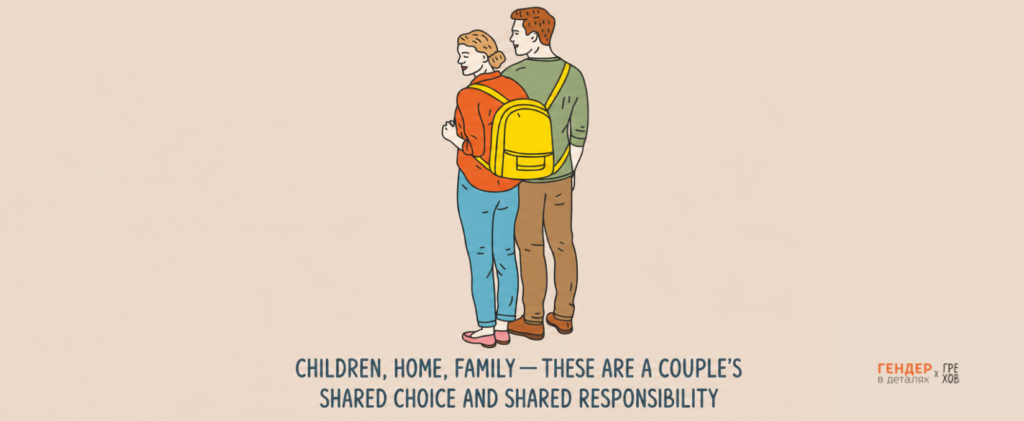
Women — don’t let anyone take from you your right to rest, to your health, to sport, to your career. A home, children, a family — these are a couple’s shared choice and shared responsibility. Both people have to carry it. If you notice your partner playing dumb to avoid being asked again, do the same. Don’t take on the role of household manager-in-chief. Ask your husband to write you a list of what needs doing. Let him remind you if something needs to be finished or bought. Divide the mental load just as you would the physical one.
What else is worth learning from men? Stop going quiet. Stop holding your tongue. Stop performing wisdom. Stop settling for less. Stop swallowing your words to smooth things over. Stop taking responsibility for the mood of an entire team. And stop doubting that your work deserves fair pay.
Feminists of the world are the guardians of survivors of rape. We developed a profound theory to expose victim-blaming. We created sensitive language to provide care and support. We fight for justice and healing for those abused.
How did it happen that when the victim was not a person but a country, all these developments were forgotten?
Despite international law deeming Russia’s attack on Ukraine an unjustified act of aggression, the prevalence of victim-blaming narratives directed at Ukraine is nothing short of staggering.
The nature of victim-blaming is always the same. It rests on three pillars.
The first: it is frightening to think that something similar could happen to you or your loved ones, so it feels safer to blame the victim for somehow behaving “incorrectly.” The unspoken promise is that if one behaves “properly,” everything will be fine.
The second: standing up for a victim requires effort — and courage — because it carries the risk of harm to oneself.
The third: a social structure — be it patriarchy, racism, or imperialism — that denies an oppressed group its rights, including the right to justice and the right to speak for itself.
What intrigues me most is that feminists in different countries have not noticed the obvious parallels between victim-blaming and the way people speak about Russia’s attack on Ukraine. These parallels are hard to miss, yet they remain largely unseen.
I want to make them clear.
The examples in this essay come from what my colleagues, friends, and I have personally heard from people in different countries — often from those with higher education, academic achievements, feminist beliefs, and best intentions.
It’s family business
The Russian war against Ukraine began in 2014 with the annexation of Crimea and parts of the Donetsk and Luhansk regions. Russia carefully concealed it, sending troops without identifying marks and later conducting so-called referendums in the occupied territories. The results of these referendums were not recognized internationally. Yet, the vast Russian propaganda machine worked to claim that there was a civil war in Ukraine. This explanation was very convenient — it allowed the international community to delay a response to violations of sovereign borders while continuing profitable trade with Russia.
It is as if you hear screams from a neighboring apartment at night and realize that a woman is being beaten and raped. But your neighbor is a respected, wealthy person, with whom it is just as risky to quarrel as it is profitable to have dealings.
So eventually, you and the other neighbors begin speculating about what really happened; perhaps she consents to, or even desires, the rough treatment.
Maria’s rape
We underestimate the scale and systemic nature of gender-based violence, in part because in our language it is seen as “belonging” to women. We read headlines that a woman was harassed, beaten, killed, raped, or that she spoke out and accused a man. Only after court verdicts do we see that someone like Harvey Weinstein was a serial rapist and abuser.
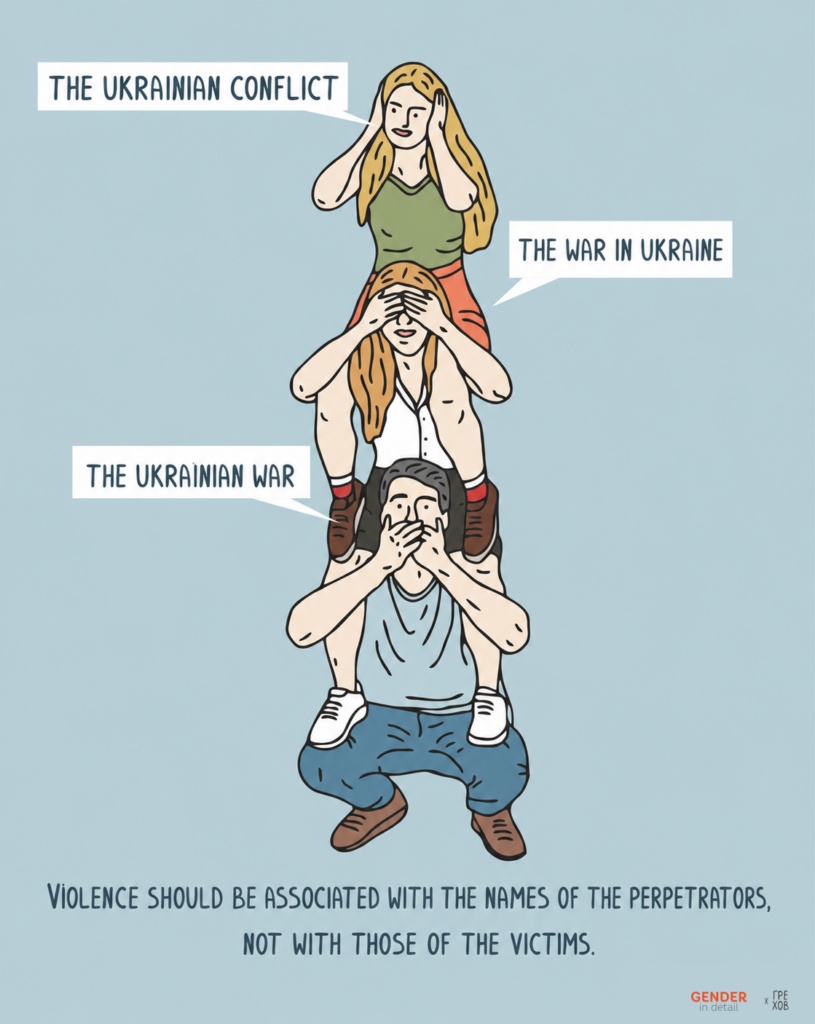
Violence should belong not to those against whom it is committed, but to those who commit it. It should be associated with the names of perpetrators, not victims.
Think of newspaper headlines: “The Ukrainian conflict,” “Ukrainian war,” “War in Ukraine.” Even “The Russian-Ukrainian war” is rare. And the correct term for this war — “Russia’s war against Ukraine” — is such a rare phrase that you are probably seeing it for the first time.
Do you know much about recent Russian wars?
They have been happening over the past 30 years, but you probably read about them under different names:
1990–1992 — War in Transnistria
1992–1993 — War in Abkhazia
1994–1996 — First Ichkeria War
1999–2009 — Second Ichkeria War
2008 — War in Georgia
2015–2024 — War in Syria
2014–present — War in Ukraine
We see the victim, but the perpetrator remains invisible.
All these wars share one thing that you would never guess from media headlines: they were all started and waged by Russia.
Perhaps, had global media in 2014 simply stated that Russia had begun yet another Russian war, the international community’s reaction would have been different, and Russia could have been stopped immediately.
She shouldn’t have provoked him
This is my favorite. It is typically employed by those who consider themselves terribly well-educated and intelligent. My Ukrainian feminist sisters and I have had to listen to a great deal of westplaining on geopolitics. That Ukraine wanted to join NATO too much, that it pursued European values and the path to EU membership too aggressively, that it didn’t cherish the Russian language and culture enough. And, in general, that it behaved with too much independence.
If Western feminists had to endure hearing from their colleagues, casually amidst the polite chatter of a scientific conference reception, that a victim was wearing a skirt that was too short, walking down the wrong street, or daring to refuse a suitor—they would surely have gone mad with rage and cancelled every single victim-blamer.
Ukrainians are forced to smile sweetly and search for arguments, even when all we want to do is scream. For were we to show righteous fury, we would simply be patted on the shoulder and declared emotional, traumatized victims from whom one cannot expect reason. Those we speak with would then go off to converse with other colleagues who keep a cool head and understand the full grandeur of the notion that Ukraine should not have provoked Russia’s war with a short skirt.
Perhaps you are now objecting that this is a manipulation, that NATO cannot be compared to a skirt. But if we agree that a woman has the right to do as she pleases, and that no one can violate her boundaries—then why, all of a sudden, does it become different when the subject is a country?
He has a right
Well, he is her husband, after all. She belongs to him. In many countries, marital rape is still not considered a crime. There is no need to explain to feminists that a man has no rights over a woman, no matter the nature of their relationship.
So why then did Ukraine suddenly begin to “belong” to Russia? Because it was occupied by it since the 17th century? Because of the Russian myths about three fraternal peoples that Putin so adores? No matter how hard Russia tries to impose the idea of a legitimate sphere of its interests, it does not exist until others accept it—until others concede that a man has the right of ownership over his spouse. I hope the world will consistently reject violence that masquerades as a right.
It’s a man’s business
Feminists around the world oppose the abduction of women and so-called honor killings, and it would never occur to anyone to agree that a woman’s body is a battlefield between men.
I have never heard of “proxy-rape,” but I have heard many times about a “proxy-war”—how America is fighting Russia with Ukrainian hands, how the USA and Russia are fighting each other (in Ukraine, for some reason).
If one reads the articles and speeches of Putin himself, he directly states that the Ukrainian people do not exist, that this territory is Russian, and his goal is to seize it, to exterminate everyone who considers themselves Ukrainian. He wants to destroy their language, culture, and identity.
This is precisely what Russians are doing in the occupied territories—they have closed Ukrainian schools, burned Ukrainian books, and forbidden the Ukrainian language. They kill, rape and torture. A strange war with the USA, isn’t it?
But this is also how rape is used in war: to destroy a people on a biological level. Not merely to inflict pain and suffering, but to genetically alter the population.
And no matter how many “proxy” prefixes one attaches to a war or a rape, it is still a crime that must be stopped and punished according to international law.
Why didn’t she just spread her legs?
“Why don’t you just give them the land?”
“She just needed to put up with it.”
“We would have accepted the occupation and done nothing.”
“So she spread her legs once, so what. Nothing terrible happened.”
“You just need to give up the territory, and then he’ll calm down.”
“She needs to agree to sex, and then it won’t be rape.”
Half of these phrases are utterly unacceptable in a civilized society. Ukrainians hear the other half regularly.
Defence make it worse
You cannot win. Russia is simply too large. Therefore, you must surrender as quickly as possible. Do not escalate with defence.
This view is shared by certain feminists who are actively demanding that the provision of arms to Ukraine be ceased.
This thought pains me as a woman. Men are generally stronger than women. In a physical fight, it is very difficult for women to defend themselves. Should we all just spread our legs and relax?
We devised rights, laws, courts, and police so that the law of the strong would not dominate on the streets. We devised international law for the same purpose. So why are we not defending it together?
She is unworthy
“Ukrainians are Nazis, uncivilized, and corrupt.”
“She’s a drug addict, an alcoholic, and a slut.”
All of feminist theory tells us that none of this is a justification for violence.
We should discuss problems and shortcomings of each and every society. We do. None is perfect.
However, such a conversation should not be used—especially at the international level—to replace the discussion of the causes of violence, nor to justify it.
He is a victim too
Of course, we can discuss how rapists are also victims of toxic masculinity.
But do you so often suggest that rape survivors should pity their rapist as you suggest Ukrainians should sympathize with Russians?
Do you seat the victim and the rapist at the same table right in the middle of the assault, and look on with fond affection as they sit together so nicely?
Do you ask the victim to think about the rapist’s mother and how she will suffer while he is in prison?
In fact, victims are asked about this. They are asked to pity the young man, not to ruin his life. But this infuriates us feminists, doesn’t it?
Pushkin, not Putin
My heart breaks when I think of all the women abused by Trump, Weinstein, and other famous bastards. What did those women feel every time their smiling abuser gave an interview on camera, surrounded by respect, success, and opportunity?
The Ukrainian request to cancel Russian culture is met with little understanding. Few people know that this culture has been used for centuries as a smokescreen for Russian crimes. While Tolstoy and Dostoevsky were translated and published, the literature of all peoples enslaved by Russia was not. While these authors were creating the image of the mysterious Russian soul, those who could have told of the genocides of their peoples were forced to remain silent and sink into oblivion.
Therefore, when Kirill Serebrennikov staged Modest Mussorgsky’s “Boris Godunov” at the Dutch National Opera in 2025, it was not merely culture. It was a denial of the chance for all victims to tell their stories.
Choice matter
I finish this essay on the day that Trump is meeting with Putin in Alaska. They say he will be met with honors and that a red carpet will be rolled out for him. A horrific war criminal, a bloody dictator who has killed millions of Ukrainians and Russians, who is abducting Ukrainian children and bombing peaceful cities, will be smiling for the cameras.
I cannot help but think that Russia could have been stopped.
In 2008 at the NATO summit in Bucharest, Ukraine and Sakartvelo (Georgia) had hoped to receive an invitation to the Membership Action Plan. However, they were denied this invitation, as members of the Alliance feared that it might provoke Russia.
Less than four months later, in August 2008, Russia launched a full-scale military invasion of Georgia.
In 2014, when Russia seized Crimea, the sanctions were weak. The Nord Stream pipelines continued to function, giving Russia the opportunity to earn billions from gas sales to finance the future greater war against Ukraine.
Every attempt to appease Russia has only resulted in it seizing more and more.
But no one seemed to learn from the obvious facts. Since 2022, Ukraine has been begging for weapons in dribs and drabs. We were told that we wouldn’t be given tanks, planes, or long-range missiles. Although finally all types of armaments were provided, precious time was lost, and most importantly—people.
This delay did not stop Russia at all. What stopped Russia was the heroism of Ukrainian soldiers—soldiers who are not some specially-bred specimens from the planet Mars, but our husbands and wives, brothers and sisters, colleagues, teachers, musicians, lawyers, those who in peaceful times are our clients and to whom we provide services.
In the end, it turned out that Russia can be provoked by weapons no more than a rapist can be by appearance. On the contrary—only force can stop them both.
The force of arms, law, solidarity—and of words. Words that shape how we think and determine how we act.
What if the media for the last 30 years were naming wars Russian regardless of who they were attacking?
What if, instead of victim-blaming discussions about how Ukraine provoked Russia, the world only spoke of unlawful aggression and how to stop it?
What if, instead of fearing the aggressor, we sought to punish him and protect the weak, to set an example for all potential perpetrators that they will get what they deserve?
What if the victims had the trust and the opportunity to tell their stories?
I don’t know what kind of appeasement Trump prepared for Russia this time. I know that unpunished evil comes back. I know that solidarity and small steps can change the world.
This study analyzes the role and readiness of women in the civil defence system of Ukraine and the possibilities of institutionally strengthening their contribution through the adaptation of international experience, in particular the Swedish model of comprehensive defence. The methodology combines quantitative data from a nationally representative survey and qualitative interviews, supplemented by an analysis of regulatory documents and data from open sources. The focus of the work is the interaction of state bodies and civil society, the development of volunteer initiatives and training programs, as well as gender-sensitive aspects of crisis preparedness. The study offers recommendations for integrating the practical experience of volunteer initiatives and training programs into systemic mechanisms for training citizens. The expected impact of these recommendations is also considered at four levels: individual, local, institutional and national. Practical implications relate to the formation of a systemic approach to training citizens and the development of resource mobilization mechanisms. The results emphasize the importance of integrating women into civil defence as a component of a sustainable and flexible security and defence system of Ukraine.
Keywords: women and security, civil defence, comprehensive defence, national resistance, Ukrainian-Swedish cooperation.
CONTENTS
BRIEF SUMMARY INTRODUCTION METHODOLOGY CHAPTER 1. INTRODUCTION TO THE CONCEPT OF TOTAL DEFENCE 1.1 Why Does Ukraine Need Total Defence? 1.2 Summary of Chapter 1 CHAPTER 2. THE CIVIL DEFENCE SYSTEM IN SWEDEN Summary of Chapter 2 CHAPTER 3. SVENSKA LOTTAKÅREN: SWEDEN’S AUXILIARY WOMEN’S DEFENCE CORPS 3.1 Case Study Analysis: Legal Framework, Functions, Responsibilities, and Organizational Programs 3.2 An overview of the organization’s training courses and identification of those adaptable to the Ukrainian context. 3.3 Summary of Chapter 3 CHAPTER 4. UKRAINE: FROM CIVIL PROTECTION TO TOTAL DEFENCE 4.1 Legislative Foundations and the Transformation of Civil Protection into Total Defence 4.2 Implementing Total Defence Principles in Practice CHAPTER 5. WOMEN’S LEADERSHIP IN CIVIL READINESS AS A COMPONENT OF TOTAL DEFENCE 5.1 Social Motivations and Challenges to Women’s Participation in the Civil Readiness System 5.2 Women’s Grassroots Initiatives in Civil Readiness: From Ad Hoc Practices to Systemic Models 5.3 Summary of Chapter 5 CHAPTER 6. CONCLUSIONS 6.1. PROPOSAL FOR IMPLEMENTING THE SWEDISH SYSTEM IN UKRAINE 6.2. RECOMMENDATIONS FOR ENHANCING THE CIVIL DEFENCE SYSTEM IN UKRAINE 6.3. POTENTIAL IMPLEMENTATION SCENARIOS: From Pilot Projects to Institutionalization The Most Realistic Scenario: Piloting and Incremental Scaling Contingency Scenario: A Civil Society Initiative 6.4. EXPECTED IMPACT of Recommendations Across Four Levels CONCLUSIONS REFERENCE Appendix A. National Survey Structure
BRIEF SUMMARY
This report examines the readiness of Ukrainian society to participate in civil defence and provides recommendations for the institutional and civic development of the system, particularly focusing on the gender dimension and the role of women in strengthening community resilience.
In the Ukrainian context, civil defence is still undergoing transformation: from a centralized model of state paternalism to a partnership-based total defence model, where all citizens actively contribute to the security and resilience of their communities. The high potential of Ukrainian civil society has already been demonstrated during the war through numerous volunteer and educational initiatives, which effectively implement total defence principles from the bottom up, mirroring the Swedish total defence model.
The study examines the current state of Ukrainian civil society’s preparedness for civil defence during the full-scale war. The results of a representative survey show that only 14.7% of citizens have undergone civil defence training since the outbreak of the war. At the same time, 43% of respondents believe that civilians should actively participate in emergency response, while 48% are ready to join after receiving appropriate training. These data demonstrate a high level of civic motivation, which, as the study shows, requires formalization and systematization through structured training and support programs.
Based on these results, the study proposes concrete steps to improve Ukraine’s civil defence system. Firstly, it is recommended to integrate civil security courses into existing programs of Centers for National Resistance Training, non-governmental organizations, and the State Emergency Service (SES). Special emphasis is placed on crisis response, evacuation, debris clearance, and other practical skills that enhance community readiness.
Secondly, the study highlights the need to establish a certification system and regular retraining for male and female volunteers. This will not only ensure that knowledge remains up-to-date but also strengthen the trust of communities and state authorities in the individuals involved.
The importance of institutionalizing women’s initiatives and civil society organizations was further emphasized. Supporting networks of women trainers and leaders in civil preparedness will facilitate gender mainstreaming in security policy, address women’s needs, strengthen social resilience, and foster the development of horizontal networks of trust.
The study also proposes a decentralized governance structure capable of responding swiftly to regional needs and integrating state programs, local communities, and civil society organizations. A study of the Swedish experience suggests that adapting the ‘Lottakåren’ model to Ukrainian realities will transform ‘enthusiastic chaos’ into an institutional pillar of total defence. The Ukrainian model, as emphasized in the study, should be built on the principles of equality, civic engagement, local resilience, and trust between the state and the community.
Overall, such an approach not only ensures security but also fosters a new culture of civic responsibility, where every citizen — regardless of gender — becomes an active participant in national defence.
The research was conducted by the CSO “Expert Resource Gender in Detail” as part of the project “Gender Mainstreaming in the Context of Comprehensive Defence”, funded by the grant “Best Practices of the Swedish Gender Approach as a Tool for Empowering Ukrainian Women to Implement Sustainable Reforms and Promote Ukraine’s European Integration”, with financial support from the Swedish Institute and in partnership with the Swedish International Liberal Centre.
The project draws on gender mainstreaming practices within Sweden’s comprehensive defence system and represents the first attempt in the Ukrainian context to explore the possibilities of implementing a Swedish-style comprehensive defence strategy in Ukraine while simultaneously integrating a gender perspective across key sectors, including the economy, care work, the armed forces, civil defence, governance, information policy, and the volunteer movement.
The project’s concept author and project lead is Tamara Zlobina, PhD in Philosophy and Head of the CSO “Expert Resource Gender in Detail”.
Project mentors and reviewers of the analytical reports: Olena Strelnyk, Doctor of Sociological Sciences Hanna Hrytsenko, Gender Expert
1. The Volunteer Movement as an Implementation of the Comprehensive Defence Strategy
1.1. The Role of the Volunteer Movement as a Component of Comprehensive Defence
1.2. Ways to Strengthen the Volunteer Movement as a Component of Comprehensive Defence
2. Women in Civil Defence
2.1. Civilian Preparedness on the Home Front and the Role of Women
2.2. Establishing a Unified Civil Defence System
3. Care Work Among Women Employees in Critical Infrastructure
3.1. The Challenges of Balancing Critical Work and Care Labour
3.2. Supporting Critical Infrastructure Employees with Domestic Care Responsibilities
4. Women and Military Service
4.1. Barriers Deterring Women from Joining the Military
4.2. Recommendations for Overcoming Barriers to Women Entering Military Service
5. Gender Sensitivity in Government Defence Communications
5.1. The Portrayal of Women in State Defence Communications
5.2. Enhancing Gender Sensitivity in State Defence and Military Recruitment Communications
6. Local Self-Government as a Component of Comprehensive Defence
6.1. The Role of Local Self-Government in Executing Comprehensive Defence Functions
6.2. Defining the Specific Role of Local Self-Government in Comprehensive Defence
7. The 1325 Agenda as a Component of Comprehensive Defence
7.1. Challenges in Implementing the 1325 Agenda at the Local Level
7.2. Strengthening the Localisation of NAP 1325
8. The Technologization of Warfare and Women’s Economic Empowerment
8.1. Opportunities for Women in Emerging Military Technologies
8.2. Economic Empowerment of Women in Emerging Military Technologies
9. Conclusions and Recommendations
The concept for the project “Gender Mainstreaming in the Context of Comprehensive Defence” was developed by philosopher Tamara Zlobina, head of the CSO “Expert Resource Gender in Detail”. Inspired by Sweden’s comprehensive defence strategy (Sveriges totalförsvar, a strategy that engages the entire Swedish society in overcoming security challenges), Tamara sought to study the Swedish experience, examine which elements of comprehensive defence are already being applied in Ukraine, and integrate a gender perspective into the Ukrainian context.
The relevance of comprehensive defence in Ukraine is evident: achieving victory requires defence reforms alongside innovative solutions in civilian life, which together will ensure a resilient and comprehensive security strategy. Amid constant Russian attacks on civilians, personnel shortages in the military, and overall resource asymmetry, national security cannot be limited to the military component alone.
Across the research areas selected for the project — volunteer movements, care work, women in the military, women in civil defence, the economy, local self-government, and information policy — the researchers propose solutions that synergistically bolster both rear-front resilience and frontline defence capabilities.
Specifically, gender-sensitive military communications impact the rate of women joining the military. Combined with the removal of other barriers, this provides an asymmetric solution to personnel shortages. Furthermore, civil readiness efforts are sustained by volunteer organisations and critical infrastructure workers, whose capacity and output are directly influenced by the expansion of care work infrastructure. Economic empowerment of women in emerging military technologies helps address personnel shortages in traditionally male-dominated rear-front professions caused by mobilisation, while simultaneously bolstering the supply of advanced technological tools to the military. Local self-governments work alongside volunteer organisations and critical infrastructure entities to enhance local security and civil readiness in implementing National Action Plans (NAPs) for United Nations (UN) Security Council Resolution 1325 on Women, Peace, and Security. Strengthening each of these components individually bolsters the rear and/or the front, but strengthening them collectively can produce a lasting and comprehensive effect on societal resilience.
Taken together, applying a gender-responsive approach to comprehensive defence will enhance defence effectiveness by increasing women’s contributions to national security.
The eight research studies conducted as part of this project demonstrate that comprehensive defence in Ukraine exists de facto, operating in a spontaneous and decentralised manner, which allows it to respond flexibly to wartime challenges. However, there is a downside: this spontaneity remains unsystematic and is resource-dependent on itself, relying on the solidarity of people who are themselves in need of solidarity. In addition to specific steps addressed to various actors at central and local levels, the research recommendations include intentions to develop a comprehensive defence strategy for Ukraine. This involves integrating spontaneous efforts into a unified system that is institutionally and resource-resilient, yet preserves flexibility and rapid response capabilities.
The idea for the project “Gender Mainstreaming in the Context of Comprehensive Defence” was conceived by the philosopher Tamara Zlobina, head of the CSO “Expert Resource Gender in Detail”. Inspired by Sweden’s Comprehensive Defence (Sveriges totalförsvar, a strategy involving the entire Swedish society in overcoming security challenges), Tamara decided to study the Swedish experience, examine which elements of comprehensive defence are already being applied in Ukraine, and adapt the gender approach to the Ukrainian context.
The relevance of comprehensive defence in Ukraine is self-evident: Ukraine’s victory in the war requires defence sector reforms and the pursuit of innovative solutions in civilian life, which together will ensure a sustainable and comprehensive security strategy. In the face of constant Russian attacks on the civilian population, military personnel shortages, and overall resource asymmetry, national security cannot be limited to the military component alone. In the research areas selected for the “Gender Mainstreaming in the Context of Comprehensive Defence” project — the volunteer movement, care work, women in the military, women in civil defence, the economy, local government, and information policy — the researchers propose solutions that synergistically bolster societal resilience in the rear and defence capabilities at the front.
KEY FINDINGS
The volunteer movement in Ukraine simultaneously cooperates with the state and fills its institutional gaps, forming an integral part of comprehensive defence. Its spontaneous and horizontal nature enhances flexibility in crisis response, while its capacity for sustainable reform remains limited.
Existing civic practices in civil defence are fragmented and insufficiently integrated into state policy. Broadly including women in civil defence strengthens both crisis preparedness resources and social cohesion.
The efficiency of balancing work in critical infrastructure with caregiving at home directly impacts societal resilience. Without a robust care infrastructure, it is impossible to unlock the full potential of human resources, particularly in critically important sectors.
The recruitment and service of women in the Armed Forces of Ukraine are hindered by institutional, legal, social, and informational gaps, as well as stereotypes. Women’s potential remains underutilised.
State communications in the defence sector have already made women visible but have not yet made them equal. Representations of women lack substance, while the topic of equal rights and opportunities for women and men lacks sufficient representation.
Societal resilience is built from the bottom up, grounded in self-organisation and interaction at the local level. In conditions of general uncertainty, local initiatives prove to be the most effective response to the challenges of war.
The implementation of the National Action Plan for United Nations (UN) Security Council Resolution 1325 on Women, Peace, and Security at the local level faces systemic gaps. Local implementers lack both capacity and coordination.
The field of emerging military technologies is growing rapidly and actively recruiting women. However, a range of barriers prevents women from reaching their full potential in this sector, thereby limiting the industry’s collective capacity.
RECOMMENDATIONS
1. Recognize the volunteer movement as an integral component of comprehensive defence.
The volunteer movement is an inseparable element of the national resilience system and comprehensive defence. Recognising it as such allows for developing a strategic vision for volunteering, paving the way for the fullest possible realisation of volunteer potential. Institutional support for volunteer initiatives must be expanded and diversified, while best practices should be scaled up and projected to the national level. Distinguishing between volunteering and charitable activities will eliminate legal gaps and enable the development of more effective policies to strengthen both categories. Collaboration between the volunteer sector and the state at both national and local levels will yield synergistic results. Applying a gender-responsive approach will strengthen the potential of both women and men.
2. Integrate state, municipal, and volunteer efforts into a unified civil defence system.
Volunteerism in civil defence, which currently fills state gaps on an ad hoc basis, must be integrated into a systemic model, taking its place as a predictable, trained, and well-resourced component. An extensive infrastructure for emergency response and national resistance training must serve as a gravity centre for volunteer initiatives and individual citizens. It should ensure the widespread dissemination of survival, resilience, and functional skills amid security challenges, while enabling the rapid mobilisation of trained citizens in emergencies. The potential of women who are not part of the military defence structure can be leveraged to strengthen civil defence.
3. Empower female employees of critical infrastructure who perform care work at home.
Integrating care work into the planning of critical functions will strengthen both the employees themselves and the quality of their work. Exposing the invisible “second shift” will allow for more flexible planning of critical public functions, resulting in additional hours worked, lower staff turnover, and higher psychological resilience within communities. A dedicated state policy, encompassing both short-term and long-term measures, must address the balance between care work and employment in critical sectors. Its key objective should be to transition the intersection of domestic labour and rear-front resilience from the realm of individual overexertion to a framework of predictable workload and predictable support.
4. Remove barriers that deter women from entering military service.
Despite significant positive changes in gender equality within the defence sector since 2014, there remains a need to remove barriers that deter women from entering military service. From providing formal opportunities to serve, which has already occurred, it is necessary to move on to eliminating practical obstacles and unequal treatment of women on the ground. The key objective should be establishing an institutional culture rooted in respect for human dignity and diversity. Eliminating the informational, socio-cultural, logistical, and other barriers identified in the study will encourage women, who are currently not subject to mandatory conscription, to enlist voluntarily. This, in turn, will significantly bolster the capabilities of the Ukrainian Defence Forces amidst the shortage of male personnel.
5. Enhance gender sensitivity in state communications regarding defence and military recruitment.
State communications in the sphere of defence and military recruitment must operate within unified standards that codify the principles of gender equality and provide clear compliance instructions. Such communications should go beyond mere formal markers of female visibility, such as the use of feminine job titles or abstract, symbolic depictions of servicewomen as “Berehynias (Guardians) in uniform.” Instead, they must actively highlight the lived experiences, achievements, and challenges of women in the military, emphasizing the vital importance of upholding their rights. Official communications must report on progress in addressing equality and discrimination issues, while also prioritising female recruitment by proactively addressing concerns relevant to a female audience.
6. Define more specifically the role of local self-government within the framework of comprehensive defence.
Comprehensive defence must be enshrined in the state’s strategic documents, while local self-government bodies and military administrations must be provided with a clear understanding and delimitation of their respective competencies, powers, and division of responsibilities. Communities involved in implementing comprehensive defence must be provided with adequate resources and support. At the local government level, local security policies and security action plans must be developed, based on coordination and interaction between local authorities, military administrations, central executive bodies, locally stationed military units, critical infrastructure services, and veteran organisations, among others. Women must be actively integrated into these policies and action plans as those who are already demonstrating leadership and implementing resilience-building measures
7. Strengthen the localisation of the National Action Plan (NAP) for the Implementation of UN Security Council Resolution 1325 on Women, Peace, and Security.
Implementers of the NAP 1325 at the local level must be properly coordinated, adequately funded, and equipped with the necessary capacities. The focus of both national and local action plans must shift from the practice of adopting “declaratory” and “top-down” mandates, which often lack resource allocation and a clear understanding of the tasks’ value, toward a collabourative search for solutions that address genuine needs and are realistically implementable at both levels. The foundation for this search for solutions must be the active engagement of communities in identifying their specific security challenges and needs.
8. Expand economic opportunities for women in the field of emerging military technologies.
Involving women in stereotypically male-dominated professions will allow them to realise their potential and offset the shortage of men who have left “traditionally male” industries to join the military. As a sector of paramount strategic importance, emerging military technology must proactively eliminate even the smallest barriers to women’s recruitment and professional growth. Investing in technical education for women and girls, eradicating workplace discrimination, ensuring inclusive environments for those with caregiving responsibilities, and enhancing female visibility should be the primary tools for empowering women in advanced military tech. The inclusion of women in emerging military technologies must be integrated into national strategic security planning.
Directions for Further Research
Food Security
Healthcare, First Aid, and Blood Donation
Energy Security
Environmental Security
Safety of Pets, Livestock, and Their Owners
Cognitive Warfare and Countering Disinformation
Cybersecurity and Physical Information Protection
Firearms Control
Veteran Policy
CONCLUSIONS
The research concludes that comprehensive defence in Ukraine exists in a spontaneous manner, manifesting at various levels, from individual initiatives to national action plans. This spontaneity is both a strength and a weakness: while flexibility allows for rapid response to wartime challenges without awaiting “top-down” approval or predefined frameworks, many best practices lack institutionalisation, rootedness, scalability, and sustainable support.
A gender-responsive approach is a vital element of comprehensive defence, as women are both the beneficiaries and the architects of social resilience practices. Advancing gender equality allows for realising women’s potential while simultaneously strengthening the aggregate capabilities of society.
Ukrainian legislation defines the concept and components of comprehensive defence in the Military Security Strategy of Ukraine (2021); however, this document remains a framework that requires updating and further specification in line with the sectors of hybrid warfare. In 2026, there is a pressing need to unify the efforts of civil society, the state, and international stakeholders to transition Ukraine’s spontaneous and fragmented comprehensive defence practices into a cohesive, institutionalised, systemic, sustainable, and effective security strategy and policy.
The comprehensive solutions proposed by the researchers across military and civil defence, the labour market, and governance will strengthen social resilience. These measures maintain flexibility in responding to wartime challenges while simultaneously providing support to those who carry out this response.
Project mentors and reviewers of the analytical reports:
Olena Strelnyk, Doctor of Sociological Sciences;
Hanna Hrytsenko, Gender Expert.
The research was conducted by the CSO “Expert Resource Gender in Detail” as part of the project “Gender Mainstreaming in the Context of Comprehensive Defence”. It was funded by the grant “Swedish Gender Approach Best Practices as a Tool for Empowering Ukrainian Women to Implement Sustainable Reforms and Facilitate Ukraine’s European Integration,” with financial support from the Swedish Institute and in partnership with the Swedish International Liberal Centre.
This study analyses the vital role and impact of the grassroots volunteering movement in Ukraine within the context of Russia’s ongoing armed aggression. It provides an overview of volunteering dynamics and the legal framework, combining quantitative and qualitative data to examine organisational forms, grassroots characteristics, and cooperation with authorities and the NGO sector. The research explores gender aspects and future prospects of grassroots efforts, including case studies of families of POWs, missing persons, and civilian hostages. It concludes with recommendations for key stakeholders on strengthening the movement for Ukraine’s comprehensive defence.
Keywords: volunteer movement, grassroots volunteering, volunteer initiatives, activism, individual volunteers, comprehensive defence, Russia’s war against Ukraine, Ukraine.
CONTENT
ACRONYMS EXECUTIVE SUMMARY INTRODUCTION METHODOLOGY CHAPTER 1. OVERVIEW OF THE VOLUNTEER MOVEMENT: LEGAL AND CHRONOLOGICAL PERSPECTIVES 1.1 Brief Overview and Analysis of the Legal Framework 1.2 Overview of Public Engagement in Volunteering and the Dynamics of the Volunteer Movement, Specifically Post-2022 1.3 Results of the Nationwide Survey on Volunteering Engagement in 2025 1.4 Summary of Section 1 CHAPTER 2. ORGANISATIONAL FORMS OF THE VOLUNTEER MOVEMENT 2.1 Typology of Volunteering: Legal Status and Areas of Activity 2.2 Challenges in Categorising Volunteering 2.3 Summary of Section 2 CHAPTER 3. CHARACTERISTICS OF GRASSROOTS VOLUNTEERING IN UKRAINE 3.1 Summary of Section 3 CHAPTER 4. INTERACTION WITH GOVERNMENT AUTHORITIES, BUSINESS, AND THE CIVIL SOCIETY SECTOR 4.1 Summary of Chapter 4 CHAPTER 5. GENDER ASPECTS OF VOLUNTEERING 5.1 Summary of Chapter 5 CHAPTER 6. THE DEVELOPMENT AND FUTURE OF GRASSROOTS MOVEMENTS 6.1 Summary of Chapter 6 CHAPTER 7. CASE STUDIES: ASSOCIATIONS OF FAMILIES OF POWs, MISSING PERSONS, AND CIVILIAN HOSTAGES 7.1 Summary of Chapter 7 CONCLUSIONS RECOMMENDATIONS REFERENCES
EXECUTIVE SUMMARY
“Until 2014, volunteers were perceived by society as some kind of freaks who had nothing better to do and were just making things up. After 2014, it became a trend, a mark of good manners. And after 2022, this trend intensified: the formula ‘you are either in the AFU or for the AFU’ became the truth. Therefore, every man and woman must make their contribution to victory.” Individual female volunteer, Interview 15
This study aims to outline how the grassroots volunteer movement complements and sustains Ukraine’s defence capabilities.
Context. In 2025, during the twelfth year of the Russo-Ukrainian War and the fourth year of the full-scale invasion, Ukraine’s grassroots volunteer movement continues to operate and evolve. In 2024, the share of the employed population involved in volunteer or charitable activities (at least once a month) was 57.7% for women and 54.4% for men. Volunteer initiatives operate across all spheres of society: from fundraising for diverse military and humanitarian needs to non-financial assistance to the Defence Forces, war victims, internally displaced persons (IDPs), veterans, and people in difficult life circumstances, as well as services in education, culture, environmental protection, and beyond. An active volunteer movement fosters greater resilience within Ukrainian society.
The research methodology is based on a mixed-methods approach, combining desk and field research. The latter involved both quantitative (a survey of 1,000 respondents via CATI based on random digit dialling) and qualitative (16 in-depth interviews) methods, partially conducted in parallel. Open-source intelligence (OSINT) and case studies were employed as supplementary methods.
Chapter 1. Overview of the Volunteer Movement: Legal and Temporal Perspectives.
This chapter provides a comprehensive review of the development of the volunteer movement in Ukraine through the prism of legal regulation and socio-historical transformations. Desk research findings indicate the gradual establishment of a volunteering culture in Ukraine: from episodic initiatives in the early 1990s to a large-scale movement integrated into various spheres today, from supporting the military to humanitarian aid during the full-scale invasion.
The legal analysis of the legislative framework underscored the importance of a clear distinction between the concepts of “volunteer” and “benefactor,” and identified the key regulatory changes that influenced the organisation and regulation of volunteer activities. Changes in the institutional structure of volunteer coordination, social guarantees for volunteers, and the legal challenges currently faced by male and female volunteers are examined separately.
The study analysed the dynamics of public engagement in volunteering, along with the results of sociological and academic research highlighting the transformation of the volunteer movement in Ukraine in recent years. Findings from the 2025 nationwide survey conducted as part of this study demonstrate steady public involvement: 41% of respondents are actively participating in volunteer initiatives, showing a relative gender balance.
Chapter 2. Forms of Organizing the Volunteer Movement.
This chapter presents various forms of volunteer organisation in Ukraine, classified based on empirical data by their legal status and spheres of activity. The primary functions of each form are analysed, and the intersections and distinctions between volunteer work and activism are explored. The overview demonstrates the diversity of the volunteer environment and reveals the specifics of its structuring and categorisation.
Chapter 3. Characteristics of Grassroots Volunteering in Ukraine.
Data from in-depth interviews provided an analysis of the specific features of grassroots volunteering in Ukraine, its horizontal structure, and social responsibility. The chapter examines the experiences of individual volunteers and volunteer initiative groups, both those formalised as civil society or charitable organisations and those remaining informal.
Chapter 4. Interaction with Authorities, Business, and the Civil Sector.
Volunteer initiatives that emerged as a response to the urgent challenges of war are gradually forming a powerful parallel system capable of performing functions traditionally belonging to the state. In-depth interview data indicate that the grassroots volunteer movement is open to cooperation with authorities, businesses, and non-profits, seeking ways to establish contacts despite perceived barriers. This chapter outlines the extent to which volunteer initiatives substitute for state functions and raises questions about the future interaction between civil society and the state.
Chapter 5. Gender Aspects of Volunteering.
This chapter examines gender dimensions and representations within Ukraine’s grassroots volunteerism. The analysis shows how the movement reflects, reproduces, and transforms traditional gender roles, influencing motivation, the nature of activities, and the division of labour. By utilising both quantitative survey data and qualitative testimonies from male and female volunteers, the study traces gender differences in tasks and sectors of involvement. Special attention is paid to the visibility of female leadership and its reflection in everyday practices and the public sphere, where gender asymmetry remains more pronounced.
Chapter 6. Development and the Future of Grassroots Movements.
This chapter analyses the evolution of Ukrainian grassroots volunteer initiatives amidst a protracted war, highlighting their needs and challenges during formalisation and professionalisation. It examines trends in the institutionalisation of volunteer hubs, reasons for maintaining the informal nature of certain initiatives, and the movement’s adaptation to emerging social needs. Based on quantitative and qualitative data, the study traces how activists redefine development strategies, strengthen horizontal ties, and enhance community resilience.
Chapter 7. Case Studies of Associations of Families of Prisoners of War, Missing Persons, and Civil Hostages.
This chapter outlines the development, characteristics, and needs of the civic movement formed by families of prisoners of war (POWs), missing persons, and civilian hostages, which has expanded rapidly in response to Russia’s aggression. It presents case study findings, analysing the composition of these associations, their geography, activities, and challenges, as well as their interaction with local authorities, government bodies, and international organisations. The focus is on civic activism and volunteer efforts aimed at advocating for the rights of victims and providing pro bono assistance to families.
Conclusions. The study summarises its key findings: the strength of the volunteer community, the fluid nature of categorisation, legal uncertainty, resource resilience, and issues of gender representation.
Recommendations. Recommendations are provided for key stakeholders on how to maintain sustainability and strengthen the grassroots volunteer movement for comprehensive defence.
The research was conducted by the CSO “Expert Resource Gender in Detail” as part of the project “Gender Mainstreaming in the Context of Comprehensive Defence”, funded by the grant “Best Practices of the Swedish Gender Approach as a Tool for Empowering Ukrainian Women to Implement Sustainable Reforms and Promote Ukraine’s European Integration”, with financial support from the Swedish Institute and in partnership with the Swedish International Liberal Centre.
The project draws on gender mainstreaming practices within Sweden’s comprehensive defence system and represents the first attempt in the Ukrainian context to explore the possibilities of implementing a Swedish-style comprehensive defence strategy in Ukraine while simultaneously integrating a gender perspective across key sectors, including the economy, care work, the armed forces, civil defence, governance, information policy, and the volunteer movement.
The project’s concept author and project lead is Tamara Zlobina, PhD in Philosophy and Head of the CSO “Expert Resource Gender in Detail”.
Project mentors and reviewers of the analytical reports: Olena Strelnyk, Doctor of Sociological Sciences Hanna Hrytsenko, Gender Expert
Project managers: Alyona Hruzina, Halyna Repetska
Nationwide Minute of Silence
01:00
Every death in war is not an abstraction.
These are people. These are losses. This is a choice we did not agree to.
When we remember, we do not allow indifference to become the norm.
Memory lives on in our actions:
– in the language we use to think;
– in the donations that can save lives;
– in the words that are not afraid to call war what it is.
None of these gestures will change the past. But they can influence the future.
We honour our defenders and all those who died as a result of russian aggression.
Gender in Detail Team
Cannot be dismissed.
This banner will disappear in a minute.
But the memory must remain.
We see you have spent 15 minutes on our site.
We hope you find it interesting and invite you to follow us on social media:
It is very important for us to know where you used this material
Write to us at info@genderindetail.org.ua about your article, student work, course, Facebook post or conversation with a friend!
The Gender in Detail Team
We use cookies to improve the site and analyze traffic. Necessary cookies are always active.
Customize consent settings
We use cookies to improve your experience on our site. Cookies help us analyze traffic and improve site functionality. Functional cookies are necessary, and without them the site cannot function properly.