289
289 
The idea for the project “Gender Mainstreaming in the Context of Comprehensive Defence” was conceived by the philosopher Tamara Zlobina, head of the CSO “Expert Resource Gender in Detail”. Inspired by Sweden’s Comprehensive Defence (Sveriges totalförsvar, a strategy involving the entire Swedish society in overcoming security challenges), Tamara decided to study the Swedish experience, examine which elements of comprehensive defence are already being applied in Ukraine, and adapt the gender approach to the Ukrainian context.
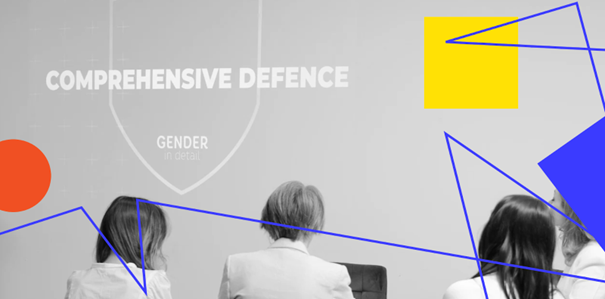
The relevance of comprehensive defence in Ukraine is self-evident: Ukraine’s victory in the war requires defence sector reforms and the pursuit of innovative solutions in civilian life, which together will ensure a sustainable and comprehensive security strategy. In the face of constant Russian attacks on the civilian population, military personnel shortages, and overall resource asymmetry, national security cannot be limited to the military component alone. In the research areas selected for the “Gender Mainstreaming in the Context of Comprehensive Defence” project — the volunteer movement, care work, women in the military, women in civil defence, the economy, local government, and information policy — the researchers propose solutions that synergistically bolster societal resilience in the rear and defence capabilities at the front.
KEY FINDINGS
-
The volunteer movement in Ukraine simultaneously cooperates with the state and fills its institutional gaps, forming an integral part of comprehensive defence. Its spontaneous and horizontal nature enhances flexibility in crisis response, while its capacity for sustainable reform remains limited.
-
Existing civic practices in civil defence are fragmented and insufficiently integrated into state policy. Broadly including women in civil defence strengthens both crisis preparedness resources and social cohesion.
-
The efficiency of balancing work in critical infrastructure with caregiving at home directly impacts societal resilience. Without a robust care infrastructure, it is impossible to unlock the full potential of human resources, particularly in critically important sectors.
-
The recruitment and service of women in the Armed Forces of Ukraine are hindered by institutional, legal, social, and informational gaps, as well as stereotypes. Women’s potential remains underutilised.
-
State communications in the defence sector have already made women visible but have not yet made them equal. Representations of women lack substance, while the topic of equal rights and opportunities for women and men lacks sufficient representation.
-
Societal resilience is built from the bottom up, grounded in self-organisation and interaction at the local level. In conditions of general uncertainty, local initiatives prove to be the most effective response to the challenges of war.
-
The implementation of the National Action Plan for United Nations (UN) Security Council Resolution 1325 on Women, Peace, and Security at the local level faces systemic gaps. Local implementers lack both capacity and coordination.
-
The field of emerging military technologies is growing rapidly and actively recruiting women. However, a range of barriers prevents women from reaching their full potential in this sector, thereby limiting the industry’s collective capacity.
RECOMMENDATIONS
1. Recognize the volunteer movement as an integral component of comprehensive defence.
The volunteer movement is an inseparable element of the national resilience system and comprehensive defence. Recognising it as such allows for developing a strategic vision for volunteering, paving the way for the fullest possible realisation of volunteer potential. Institutional support for volunteer initiatives must be expanded and diversified, while best practices should be scaled up and projected to the national level. Distinguishing between volunteering and charitable activities will eliminate legal gaps and enable the development of more effective policies to strengthen both categories. Collaboration between the volunteer sector and the state at both national and local levels will yield synergistic results. Applying a gender-responsive approach will strengthen the potential of both women and men.
2. Integrate state, municipal, and volunteer efforts into a unified civil defence system.
Volunteerism in civil defence, which currently fills state gaps on an ad hoc basis, must be integrated into a systemic model, taking its place as a predictable, trained, and well-resourced component. An extensive infrastructure for emergency response and national resistance training must serve as a gravity centre for volunteer initiatives and individual citizens. It should ensure the widespread dissemination of survival, resilience, and functional skills amid security challenges, while enabling the rapid mobilisation of trained citizens in emergencies. The potential of women who are not part of the military defence structure can be leveraged to strengthen civil defence.
3. Empower female employees of critical infrastructure who perform care work at home.
Integrating care work into the planning of critical functions will strengthen both the employees themselves and the quality of their work. Exposing the invisible “second shift” will allow for more flexible planning of critical public functions, resulting in additional hours worked, lower staff turnover, and higher psychological resilience within communities. A dedicated state policy, encompassing both short-term and long-term measures, must address the balance between care work and employment in critical sectors. Its key objective should be to transition the intersection of domestic labour and rear-front resilience from the realm of individual overexertion to a framework of predictable workload and predictable support.
4. Remove barriers that deter women from entering military service.
Despite significant positive changes in gender equality within the defence sector since 2014, there remains a need to remove barriers that deter women from entering military service. From providing formal opportunities to serve, which has already occurred, it is necessary to move on to eliminating practical obstacles and unequal treatment of women on the ground. The key objective should be establishing an institutional culture rooted in respect for human dignity and diversity. Eliminating the informational, socio-cultural, logistical, and other barriers identified in the study will encourage women, who are currently not subject to mandatory conscription, to enlist voluntarily. This, in turn, will significantly bolster the capabilities of the Ukrainian Defence Forces amidst the shortage of male personnel.
5. Enhance gender sensitivity in state communications regarding defence and military recruitment.
State communications in the sphere of defence and military recruitment must operate within unified standards that codify the principles of gender equality and provide clear compliance instructions. Such communications should go beyond mere formal markers of female visibility, such as the use of feminine job titles or abstract, symbolic depictions of servicewomen as “Berehynias (Guardians) in uniform.” Instead, they must actively highlight the lived experiences, achievements, and challenges of women in the military, emphasizing the vital importance of upholding their rights. Official communications must report on progress in addressing equality and discrimination issues, while also prioritising female recruitment by proactively addressing concerns relevant to a female audience.
6. Define more specifically the role of local self-government within the framework of comprehensive defence.
Comprehensive defence must be enshrined in the state’s strategic documents, while local self-government bodies and military administrations must be provided with a clear understanding and delimitation of their respective competencies, powers, and division of responsibilities. Communities involved in implementing comprehensive defence must be provided with adequate resources and support. At the local government level, local security policies and security action plans must be developed, based on coordination and interaction between local authorities, military administrations, central executive bodies, locally stationed military units, critical infrastructure services, and veteran organisations, among others. Women must be actively integrated into these policies and action plans as those who are already demonstrating leadership and implementing resilience-building measures
7. Strengthen the localisation of the National Action Plan (NAP) for the Implementation of UN Security Council Resolution 1325 on Women, Peace, and Security.
Implementers of the NAP 1325 at the local level must be properly coordinated, adequately funded, and equipped with the necessary capacities. The focus of both national and local action plans must shift from the practice of adopting “declaratory” and “top-down” mandates, which often lack resource allocation and a clear understanding of the tasks’ value, toward a collabourative search for solutions that address genuine needs and are realistically implementable at both levels. The foundation for this search for solutions must be the active engagement of communities in identifying their specific security challenges and needs.
8. Expand economic opportunities for women in the field of emerging military technologies.
Involving women in stereotypically male-dominated professions will allow them to realise their potential and offset the shortage of men who have left “traditionally male” industries to join the military. As a sector of paramount strategic importance, emerging military technology must proactively eliminate even the smallest barriers to women’s recruitment and professional growth. Investing in technical education for women and girls, eradicating workplace discrimination, ensuring inclusive environments for those with caregiving responsibilities, and enhancing female visibility should be the primary tools for empowering women in advanced military tech. The inclusion of women in emerging military technologies must be integrated into national strategic security planning.
Directions for Further Research
-
Food Security
-
Healthcare, First Aid, and Blood Donation
-
Energy Security
-
Environmental Security
-
Safety of Pets, Livestock, and Their Owners
-
Cognitive Warfare and Countering Disinformation
-
Cybersecurity and Physical Information Protection
-
Firearms Control
-
Veteran Policy
CONCLUSIONS
The research concludes that comprehensive defence in Ukraine exists in a spontaneous manner, manifesting at various levels, from individual initiatives to national action plans. This spontaneity is both a strength and a weakness: while flexibility allows for rapid response to wartime challenges without awaiting “top-down” approval or predefined frameworks, many best practices lack institutionalisation, rootedness, scalability, and sustainable support.
A gender-responsive approach is a vital element of comprehensive defence, as women are both the beneficiaries and the architects of social resilience practices. Advancing gender equality allows for realising women’s potential while simultaneously strengthening the aggregate capabilities of society.
Ukrainian legislation defines the concept and components of comprehensive defence in the Military Security Strategy of Ukraine (2021); however, this document remains a framework that requires updating and further specification in line with the sectors of hybrid warfare. In 2026, there is a pressing need to unify the efforts of civil society, the state, and international stakeholders to transition Ukraine’s spontaneous and fragmented comprehensive defence practices into a cohesive, institutionalised, systemic, sustainable, and effective security strategy and policy.
The comprehensive solutions proposed by the researchers across military and civil defence, the labour market, and governance will strengthen social resilience. These measures maintain flexibility in responding to wartime challenges while simultaneously providing support to those who carry out this response.
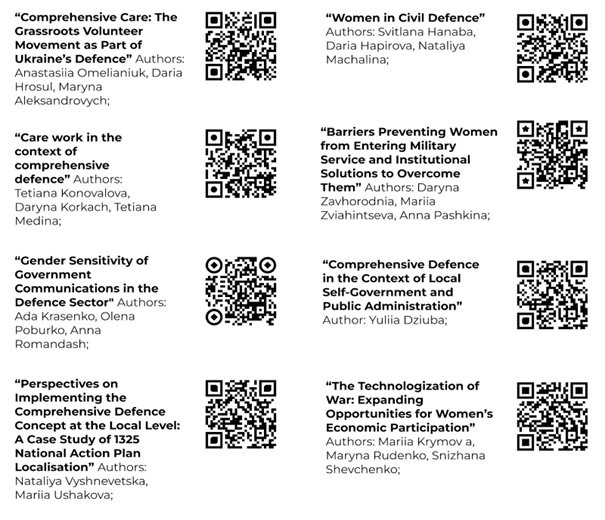
Project mentors and reviewers of the analytical reports:
Olena Strelnyk, Doctor of Sociological Sciences;
Hanna Hrytsenko, Gender Expert.
The research was conducted by the CSO “Expert Resource Gender in Detail” as part of the project “Gender Mainstreaming in the Context of Comprehensive Defence”. It was funded by the grant “Swedish Gender Approach Best Practices as a Tool for Empowering Ukrainian Women to Implement Sustainable Reforms and Facilitate Ukraine’s European Integration,” with financial support from the Swedish Institute and in partnership with the Swedish International Liberal Centre.